Categories
Science Poetry

On the Table

“The chart periodic will settle
Much chem data known, in fine fettle
And space economic:
Ranked numbers atomic
Yield elements’ proving their mettle.”

The 3 April 2023 limerick provided yet another ode to the Periodic Table of the Elements (PTE), which is undoubtedly my most common disciplinary theme.  As with the commonalities in the “start of the month” poems, PTE-related phrases accumulate quickly, so that I sometimes run into a challenge with avoiding rhymes I’ve used before, but this was one where the pun at the end clearly distinguished it from previous work!

“The chart periodic will settle / 
Much chem data known, in fine fettle /
And space economic…”

Certainly, the big themes of this poem are also ones I’ve summarized here in essay form previously, and so I hope this post does not seem too redundant.  

In 1869, Dmitri Mendeleev published his precursor to the modern Periodic Table of the Elements (PTE).  This “chart periodic” was a major step forward for chemists, given its organizational and predictive power.  Much had previously been known about specific, individual elements, but such a coordinated presentation, regarding multiple elements at once, was a significant advance.  

The PTE communicates a tremendous amount of information (“much chem data known”), effectively and compactly (“in fine fettle and space economic”).   

“Ranked numbers atomic /
Yield elements’ proving their mettle.” 

Mendeleev’s PTE used atomic weight to order the elements; the modern PTE uses atomic number (the number of protons in an atom of each element), which gives a slightly different order (“rank”).  The PTE allows elements to “prove their mettle,” or demonstrate their properties, in a visually convenient way.  

This last line also allows for a play on words with the homophones “mettle” and “metal,” because one of the immediate conclusions a chemist can draw from the PTE is whether or not an element is a metal or a non-metal!  Elements with metallic character are on the left side of the PTE; elements with non-metallic character are on the right side; and elements with aspects of both metals and non-metals, known as metalloids, form the shape of a “staircase” between these regions on the PTE.  The majority of elements on the PTE are metals

Categories
Science Poetry

Seasonal Turnover

“The treetops, consistently towering
Through sunshine and April’s rain-showering;
Now, branches connecting 

With blooms, intersecting:
The structures, once-skeletal, flowering.”

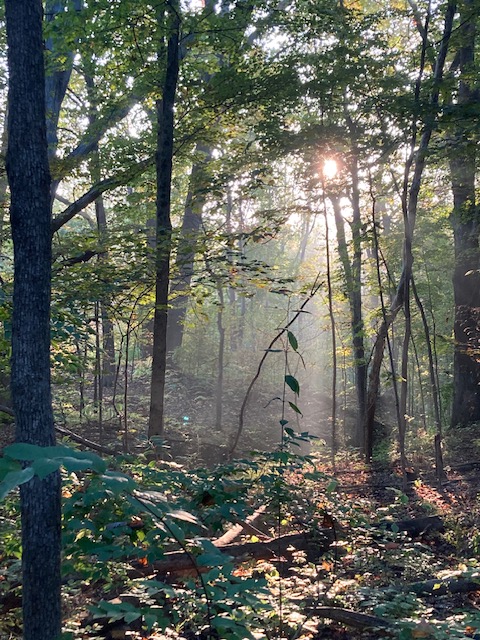
The 2 April 2023 Twitter limerick used a theme from organic chemistry to note the approach of spring weather.  It is somewhat unusual in its structure for two reasons: first, that the organic chemistry term is not introduced until the very end, so there’s not the same benefit in a line-by-line explanation; second, that it had an accompanying photo (included here, as well).  The title here alludes to both the change of seasons and the idea of “turning over a new leaf.”   

“The treetops, consistently towering
Through sunshine and April’s rain-showering…”

I am fortunate to have a few hiking trails near my home, and it is reliably reassuring to watch the scenery change throughout the seasons.  In particular, I enjoy watching the trees shift from summer to fall and winter to spring, each year: while the leaves fall and grow, the trees themselves are consistent.       

“Now, branches connecting /
With blooms, intersecting: /
The structures, once-skeletal, flowering.”

In organic chemistry, skeletal structures are drawing conventions that simplify depictions of complicated molecules by focusing on the hydrocarbon connectivity patterns (the “carbon skeleton”).  The only atoms shown in skeletal structures are heteroatoms: those that are NOT carbon or hydrogen.  

For instance, the molecule ethane consists of two carbon atoms connected to one another, with each carbon atom further connected to three hydrogen atoms; in its skeletal structure depiction, it is simply a line.  The molecule propane, in which three carbon atoms are connected to one another, looks like a V when written out in a skeletal structure.  The utility of such a convention for efficient communication becomes much clearer with increasingly complex structures.  

Tree branches in late winter, before the season turns and their new leaves and blossoms flourish, always remind me of this drawing convention.  As spring arrives, “the structures, once-skeletal, [are] flowering.”

Categories
Science Poetry

Circling Back

“Concurrent with April’s start, breaking;
Endeavor’s syllabic placemaking 
Finds light-verse-attempting
With STEM intercepting;
Fifth chemical-verse undertaking.”

As the cycle of an academic year returns to its starting line with the beginning of classes, it makes sense to restart these weekly posts, as well.  The 1 April 2023 Twitter limerick marked the start of my fifth attempt at completing the routines of National Poetry Writing Month (also known as NaPoWriMo).  

“Concurrent with April’s start, breaking…”

With my own creative writing, the start of each April since 2019 has also brought the start of this poetic effort.  In NaPoWriMo, the goal is to complete one poem per day, resulting in thirty new poems over the month of April. 

“Endeavor’s syllabic placemaking /
Finds light-verse-attempting /
With STEM intercepting…”

Finding different ways to describe this April routine, without repeating past words or phrasings, has been an intriguing challenge as synonyms for “poem” and “verse” quickly dwindle.  “Syllabic placemaking” was a new descriptor.  (I should also note that the actual poem accidentally used “attempt” twice in two lines, so I am glad for the chance to revise slightly here!)  

The third and fourth lines sum up the perpetual goal of this writing project: to use the accessible structures of limericks and other light verse to communicate scientific concepts more effectively (“light-verse-attempting with STEM intercepting”).  

“Fifth chemical-verse undertaking.”

Because my NaPoWriMo attempts began back in 2019, this 2023 trial marks the fifth such attempt at a scientific poetry project.  This is a rather predictable essay, as it’s now one of multiple posts introducing such a month-long April effort!  However, it is still useful to find some space for creative writing as the academic year “circles back”— as autumn classes and meetings begin yet again (as described by one of the most ubiquitous workplace-email phrases for revisiting a topic).  Future weeks will have more of a chemistry-specific theme. 

Categories
Science Poetry

Presentations Past

“Early-August-ly,
The chemists will congregate,
Sharing ideas ere
Nearing school year:
Posters presented and
Talks documented in
Campus-set West Lafayette.
(We are here!)” 

This is the final post in a project that used a 2022 conference talk to provide the subject for five 2023 summer essays.  This poem was posted on Twitter to celebrate the conference, but I haven’t expanded it in this space previously, so it provides a logical topic for the final July 2023 post.         

“Early-August-ly, /
The chemists will congregate, /
Sharing ideas ere /
Nearing school year…”

The substance of my 2022 talk was addressed in the last few posts, so this final essay highlights the conference itself. This presentation was part of the Biennial Conference on Chemical Education (BCCE), held at Purdue University (in West Lafayette, Indiana) in 2022. 

While I have also attended larger conferences, such as those hosted by the American Chemical Society, I find the teaching focus of the BCCE to be particularly helpful as the calendar winds toward the start of autumn coursework (i.e., “early-August-ly”), and I have presented at multiple BCCEs in the past.   

“Posters presented and /
Talks documented in /
Campus-set West Lafayette. /
(We are here!)” 

In the field of chemistry, conferences involve two types of presentations: posters and talks.  Both of these are more ephemeral than articles and book chapters, which is part of the reason I have found it rewarding to revisit the topic in written text, in this space. 

Writing this series of summer essays has thus been a fitting variation on the iterative, periodic routine that informs so many of these posts: a chance to return to a topic in a more deliberate way.  Such a conclusion is particularly useful to remember as the academic year draws near to its cyclic structure’s starting line, yet again, in 2023.  

I plan to pause posts here until classes resume, then return to the routine of translating a content-focused poem each week, as this timeline has been helpful in navigating past autumn terms.  

Categories
Science Poetry

Chemistry Coordination

STEM fields can seem oft-disconcerting;
Verse forms can be structure-asserting…
Rhymed stories, presented,
And jargon, contended–
A wall to a bridge thus converting.

The fourth post of this planned five-post series builds on a non-Twitter poem that I wrote for the presentation in question.  The poem, in turn, builds on an insightful quote from the American Association for the Advancement of Science, about the challenges of science communication.  “Chemistry coordination,” in the post’s title, inverts the name of a specific field of study (coordination chemistry) to evoke the idea of collaborative aims, via the intersection of chemistry content and light-verse forms.

“STEM fields can seem oft-disconcerting; /
Verse forms can be structure-asserting…”

The first portion of this 2022 talk presented the structures of limericks and double dactyls, as well as their use in my creative writing about science. The second shifted to a discussion of potential uses in science communication: the way that the “structure-asserting” nature of a verse can help an interested learner navigate an “oft-disconcerting” scientific discipline.     

Science communication (often abbreviated SciComm) is a complex academic field of its own, so I am aware that my discussion here, as a scientist interested in language and communication, is rudimentary at best.  However, two themes that I have seen consistently reiterated in both academic and social media settings for SciComm include the importance of story/narrative in communicating science and the challenges that jargon can pose, points that both align strongly with insights and realizations from my own educational path.  

One particularly powerful quote is available via the American Association for the Advancement of Science, from Joe Heimlich: “Jargon can be, in my mind, a tool, a weapon, a wall, and/or a bridge. Jargon is important shorthand within a field, but that language can be used to keep others out, or to shut others down.”  

“Rhymed stories, presented, /
And jargon, contended– /
A wall to a bridge thus converting.”

The science poems I write have two main goals: to concisely share a scientist’s biography or to deliberately simplify jargon.  

For a sample biographical poem, my hope is that these can be read by either a chemistry learner or a chemistry expert, and that while each audience might take away different points, both types of points would be useful.  Revisiting the poem posted in honor of Alice Augusta Ball, for instance, anyone could read this poem and learn Professor Ball’s name, as well as note the importance of her research to the field of medicine.  A chemist would likely be able to further discern details about her work and the specific insight that she brought to her research question.  (Both sets of conclusions are expanded in the pertinent essay about that poem.)  

With a sample “jargon-contending” poem, my goal is to alleviate the challenging vocabulary a bit by engaging with those terms simply as words: using rhymes, reliable verse structure, and predictable metric feet.  The poem and post about valence-shell electron-pair repulsion (VSEPR) theory, for examples of this type, both aim to first communicate the big picture: this theory efficiently predicts molecular shapes based on the fact that electron pairs repel one another.  The poem does so with some everyday language, relative to textbook presentations; my aim is that the intentionally humorous tone of light verse can minimize concerns arising from the lack of precision.        

The last line of the poem sums up my goal with these efforts, alluding to the AAAS quote: I hope these poems can convert scientific language from “a wall to a bridge,” allowing the vocabulary and stories to provide a creative way into chemistry material, rather than a barrier to learning.

Categories
Science Poetry

Constructive Overlap

Higgledy-piggledy…
Double dactylic: a
Verse structure off’ring more
Syllabic space. 
Themes are expanding with
Project longstanding as
Concepts, biographies
Gather apace.  

This is the third part of an ongoing, likely-to-be-five-part project, expanding on a presentation from 2022 to provide an “asynchronous” essay series on the same topic.  This specific post will discuss how I have used a modification of the double-dactyl form in some science poetry work. 

This is a poem type that tends to be less familiar than the limerick, so I’ve included a new, non-Twitter example around which to build this essay.  (The title of this post is adapted from a phrase related to chemical bond formation; here, it alludes to the rewarding interconnections I’ve seen in the fields of chemistry and poetry.)

Higgledy-piggledy… /
Double dactylic: a /
Verse structure off’ring more /
Syllabic space.

The double dactyl form is newer than the limerick form, and its provenance is more definitive.  Paul Pascal, Anthony Hecht, and John Hollander developed the extensive rules for this poem, memorably nicknamed the “higgledy piggledy,” in the mid-twentieth century.    

In this eight-line poem, the meter is dactylic throughout [DAH-dah-dah (e.g., “PO-et-ry”)], with a rhyme between lines 4 and 8.  To be a true double dactyl, the first line should consist of nonsense words, the second of a referenced name of some variety, and one line should itself be a single unique six-syllable, double-dactylic word.  

My own poems rarely meet all of those precise requirements!  However, compared to the five lines of the limerick, the double dactyl offers more “syllabic space” with which to work, and so for many topics, it has been slightly more flexible.  

Themes are expanding with /
Project longstanding as /
Concepts, biographies /
Gather apace.”  

In my experience, this form has held particular promise for explaining a concept in a memorable way or telling a scientist’s story.   

***

My chemistry limerick project ended on 30 April 2019, so I faced the predictable question of “now what?” on 1 May 2019.  I was aware it wasn’t sustainable to keep the effort going indefinitely, and I deliberately paused for a while.  

Later that summer, as I’ve described elsewhere on this site, I found a Periodic Poetry writing contest that inspired a double-dactyl-esque poem about Dmitri Mendeleev, commemorating the 150th anniversary of his publishing the precursor to the modern Periodic Table of the Elements.  The contest and recognition were both rewarding at a challenging time of the year, inspiring me to keep trying with this sort of creative work.  In the years since, I have continued to post poems regularly for National Poetry Month (April) and National Chemistry Week (October), with the occasional effort in between, and I have regularly expanded those poems into essays on this website as well. 

Interestingly, in negotiating scientific jargon, I notice that certain anapestic or dactylic feet will automatically emerge, a fact that often discerns between the limerick or double-dactyl form.  A salute to the “stoichiometrical” or the “macromolecular,” for instance, would automatically require the latter!  I also greatly enjoy highlighting the stories of scientists, and I’ve seen that full names often fit well into this dactylic format: Percy L. Julian, Josiah Willard Gibbs, and Alice Augusta Ball, to name a few.          

As I’ve experimented with light-verse forms throughout the years, I have become increasingly interested in their potential for effectively communicating introductory science stories and principles, as the homepage here notes. 

Categories
Science Poetry

Rhymes and Reasons

“Consider the lim’rick emphatic;
Mark feet anapestic-syllabic.
(Aside– parenthetic;
Perhaps exegetic.)
Deliver the punchline dramatic!”

This is the second part of what I imagine will be a five-post project in total, developing a conference talk I gave last summer into a piece of prose.  This post will discuss how I have used the limerick form in some science poetry endeavors.   Serendipitously, it works well to use a Twitter poem I’ve never “expanded” here before, posted on 12 May 2022 for National Limerick Day, as an introduction.   

“Consider the lim’rick emphatic; /
Mark feet anapestic-syllabic…”   

This Twitter poem was one in which some of the rules of the “limerick emphatic” were presented via the familiar structure of the limerick itself.  The metric feet used in the limerick are anapests (e.g., “in-ter-VENE”) or amphibrachs (e.g., “con-DI-tions”), depending on where the line breaks occur.  Moreover, lines 1-2 in a limerick are often those that set out the premise or subject of the verse (as in Edmund Lear’s “There was an old man of Thermopylae” and many others).   

“(Aside– parenthetic;
Perhaps exegetic.)
Deliver the punchline dramatic!”  

The rest of this poem presents a commentary on the humorous, light nature of the limerick, noting how the AABBA rhyme scheme can allow particularly well for a parenthetical or explanatory side comment in lines 3-4, as well as a punchline or insight in line 5.  

***

I’ve written previously about how April 2019 was a fortuitous month in that it was the overlap of National Poetry Month and the International Year of the Periodic Table: the juxtaposition was enough motivation to deliberately celebrate my interest in both chemistry and poetry.  I joined Twitter that spring and enjoyed the specific challenge of posting 30 poems in 30 days, relating the limericks to some of the science stories and concepts I had taught most often over the past several years.  

The limerick form has been in use for centuries; its famous structure was crucial in facilitating this initial interdisciplinary step.  It had previously been challenging, in my own experience, to find a way to combine chemistry and language as two fields of interest; indeed, that sentiment could someday be expanded into its own set of essays.  However, to keep the comment more germane to this theme: an academic career in STEM involves much writing, but that writing is primarily informative, rather than creative.  Moreover, the tension of accessibility and precision is one I still work to balance when presenting scientific vocabulary as a teacher, and I’m confident this will be a challenge throughout my career.  Knowing the “rules” for the limerick, as well as the limerick’s humorous nature, provided enough structure, yet flexibility (speaking of tension!), with which to begin this science writing endeavor.  

I was pleased to succeed at writing 30 poems in that initial April project.  It was striking how reframing my understanding of varied chemistry concepts (such as covalent bonding and the gold foil experiment) in these poems distilled such topics down to their essentials, which would also benefit my teaching in subsequent years. 

Categories
Science Poetry

Conference, Tabled

Revisiting past presentation
Of time-limit/slide-share persuasion;
Extending dispersive 
In next month’s four verses: 
Throughout summer, prose motivation.  

Once again, June 30 has somehow already arrived; once again, it is worth taking some deliberate time to plan for more creative writing in July, to make sure I don’t lose track of the entire season.  This year, I will use the next four weeks to expand on a conference presentation that I gave last summer, which overlaps with several of the topics discussed on this website.  

Revisiting past presentation / 
Of time-limit/slide-share persuasion…

As noted above, this will be a chance to expand on an academic presentation in a less formal mode.  For me, such talks can be challenging given their time constraints and the accompanying need to create a set of slides (PowerPoint, etc.) for a central focus; they are a medium of the “time-limit/slide-share persuasion.” 

The title of this post alludes to the fact that these essays will have a similar theme to last year’s conference presentation, although revisiting the theme in this form has involved a delay: this second look has been “tabled” for a while.          

Extending dispersive /
In next month’s four verses…

Over the course of the next four weeks, I will expand on each of four general points from the talk: limericks in science poetry; double dactyls in science poetry; main themes of science communication; and general references and resources.

As has become the norm for these posts, I will introduce each of these themes in a brief verse, then “extend [the theme] dispersive,” including more supporting nuance via a brief essay.  This routine will ideally continue through each Friday in July.  

Throughout summer, prose motivation.  

It is even more remarkable this year than in some previous summers how quickly the month of June flew by, via academic-year-ending paperwork and previously postponed appointments.  The past two summers’ mini-projects have been useful in converting brief poems from the stuff of marginalia to more substantive writing, using July as effectively as possible; ideally, such “prose motivation” will continue again in the month ahead.  

Categories
Science Poetry

Finished Lines

“Month’s poems, chem-themed, are completing
This April’s fourth trial, repeating;
A welcome colliding
Of science and writing,
Towards May and the summer, proceeding.”  

The last limerick from the April 2022 iteration of National Poetry Writing Month was posted on 30 April 2022.  After a limerick-structured salute to Finals Week the day before; the April 30 post was likewise predictable in theme, focusing on the end of the month.  It provides a good place to pause here at the end of the Spring 2023 semester, as well.     

“Month’s poems, chem-themed, are completing / 
This April’s fourth trial, repeating…”

Though I’ve never kept one, I have always noted the appeal of the five-year diary, in which the writer records only one line per date, but then has a chance to automatically return to (for instance) the April 26 of “year x” in “year x + 1,” “year x + 2,” etc., in completing the subsequent lines assigned to the same date.  The cyclical reflection inherent in keeping up with a written record for such a long time has always seemed appealing.  Realistically, this writing routine is the closest I’ll come to a record like that one; it’s been interesting to look back over the past four Aprils, via these essays.  

The first time I attempted this practice was April 2019, for the overlap of the Year of the Periodic Table and National Poetry Writing Month.  By the time April 2020 arrived, the world had fundamentally changed, due to the pandemic, and the poems reflected that.  Each subsequent April has seemed a bit more familiar, to the point that this year’s parallel poetic posts, over on Twitter, focus almost completely on chemistry notation and concepts yet again.        

“A welcome colliding /
Of science and writing, /
Towards May and the summer, proceeding.”  

The end of the semester is predictably challenging, as deadlines, due dates, and celebrations all collide in academic buildings and events.  It has consistently helped to have a deliberate writing structure in these two spaces, with the Twitter poems from a given April informing the following April’s essays here. 

As with previous years, I will pause posts in this space for a few weeks, as the calendar moves on to the summer. 

Categories
Science Poetry

Mere Images

“These chem terms are far from generic:
First noted with acids, tartaric;   
The handed behaviors 
That explain endeavors: 
R/S forms, enantiomeric.”

The 28 April 2022 Twitter limerick described some context and vocabulary related to enantiomers: compounds that are identical in connectivity but in terms of their three-dimensional structures are non-superimposable mirror images. 

“These chem terms are far from generic: /
First noted with acids, tartaric…”

The first few lines note that this poem will introduce some precise vocabulary, “far from generic,” for stereochemical properties of chemical species.  

The properties described here were observed by Louis Pasteur in 1847 with crystal samples derived from tartaric acid.  Using a magnifying glass, a pair of tweezers, and (presumably) no small amount of patience, he separated the pertinent crystals into two piles based on their optical properties: one set of crystals rotated plane-polarized light in a clockwise direction, while the other rotated plane-polarized light in a counter-clockwise direction.  

This difference in optical activity is the only difference in physical properties for enantiomers: in other physical properties (like melting or boiling points), they are identical.  

“The handed behaviors /
That explain endeavors: / 
R/S forms, enantiomeric.”

Stereochemistry involves the three-dimensional (3-D) arrangement of atoms in a molecule, rather than the molecule’s composition or connectivity.  Enantiomers, specifically, demonstrate “handed behaviors”; they are non-superimposable mirror images of one another, just as hands are.  This 3-D-specific information can be delineated in a variety of ways; a common shorthand is called R or S notation.  

As stated above, enantiomers have identical physical properties aside from their optical activity; however, their chemical reactivities differ in chiral environments.  In those cases, the R enantiomer of a molecule would react differently than the S enantiomer: “the handed behaviors… explain endeavors,” or chemical reactivities.  

The depictions of these “mirror-image” compounds can seem simple and often can look identical at first glance (resulting in the post’s title!).  However, once discerned, the “handed” differences in their three-dimensional compositions would have significant implications for how such molecules behave.