Coccinella bipunctata’s Journey home: linguistic data. Metric feet in names, abounding; Trochees’ constant rhythm, sounding. Lunar leap from one bos taurus; Strigidae as wisdom’s chorus; Ovis aries, fleece-donating: Latin names and verse conflating.
This is a non-NaPoWriMo poem that came to mind this autumn, rather than last April.
It takes its inspiration from a wonderful quote from Dr. Percy Julian, an organic chemist who spoke candidly about the challenges of jargon within the field, citing another scientist, Sir J. B. S. Haldane:
“I don’t want to frighten those of you who are not familiar with organic chemistry. I should have said in the beginning that one hardly expects an organic chemist to be able to speak without his gobbledygook in his language. As a matter of fact, one hardly expects a scientist to speak without that, and therefore scientists are usually and traditionally poor speakers, I warn you… The late Sir J. B. S. Haldane, the great biologist, put it rather aptly when he said that our language doesn’t lend itself to poetry. ‘Ladybird, ladybird fly away home’ becomes impossible when you must call the ladybird Coccinella bipunctata.”
The quote here refers to the scientific use of binomial nomenclature as a particularly specific type of jargon.
Coccinella bipunctata’s Journey home: linguistic data.
Every time I’ve heard this fantastic quote, I’ve appreciated it– while also still hearing a rhythm inherent in the Latin name that Dr. Julian cites! In drafting this poem, I reclassified the ladybird’s flight as “linguistic data.”
Metric feet in names, abounding; Trochees’ constant rhythm, sounding.
The next two lines highlight the metric foot in Coccinella bipunctata, which is the trochee, a two-syllable foot where the accent is on the first syllable (e.g., LADder, TIger). The trochee is the mirror image of the iamb, a two-syllable foot where the accent is on the second syllable (e.g., exIST, aMUSE, deLIGHT).
As a sidenote, a favorite discovery since beginning this website has been Isaac Asimov’s “You, Too, Can Speak Gaelic,” in which he comments on the “drumming dactylic feet” of chemical nomenclature (e.g., AL-de-hyde). It’s interesting to think about whether these metric trends are pronounced overall, in the different naming systems.
Lunar leap from one bos taurus; Strigidae as wisdom’s chorus; Ovis aries, fleece-donating…
The next few lines cite celebrated animals from various verses, in terms of their Latin names. Respectively, these are: the cow that jumped over the moon; “wise old owls” dwelling in their tree (using the family name here to suit the rhyme scheme!); and sheep of various hues and homes, all from famous nursery rhymes.
Latin names and verse conflating.
One of my main themes here is that jargon can be intimidating, but it also carries with it one same benefit that everyday words do: it can be used in rhymes that are fun to read. This poem is a direct acknowledgement of my ongoing goal in that regard.
“A fluttering, dancing occasion / ‘Twixt floral and bay wave equations? / The hue of the daffodil: / Absorption of xanthophyll! / Chem words, worth poetic persuasion.”
The 7 April 2025 Bluesky limerick was posted in honor of poet William Wordsworth’s birthday; he lived from 1770-1850, and along with Samuel Taylor Coleridge, he was one of the most famous Romantic poets. The limerick took significant poetic license in describing some science-art overlaps evoked by the images in one of Wordsworth’s most famous poems, “I Wandered Lonely as a Cloud.”
(I doubt that such sentiment would’ve been particularly beloved in that era, but then again, Wordsworth was part of the interdisciplinary science-poetry efforts with contemporaries Samuel Taylor Coleridge and Sir Humphry Davy that I’ve greatly enjoyed learning about and have written about before, on this site!)
“A fluttering, dancing occasion / ‘Twixt floral and bay wave equations?”
“I Wandered Lonely as a Cloud” recounts Wordsworth’s famous sight of “a crowd, / A host, of golden daffodils…/ Fluttering and dancing in the breeze.” The poet memorably describes the “sprightly dance” as these flowers bob in the wind beside nearby water, and he observes, likewise vividly, that the sun-dappled bay nearby cannot compete: “The waves beside them danced; but they / Out-did the sparkling waves in glee.”
This particular limerick was meant as a birthday homage to Wordsworth. Wave equations generate graphs that represent wave behavior. In alluding to some of the way waves come up in a scientific environment, the poem imagines the mathematical descriptions of these famous poetic motions– a.k.a., “floral and bay wave equations.”
“The hue of the daffodil: / Absorption of xanthophyll!”
Even more clinical-sounding, I fear, is the link in lines 3-4 between the color of the daffodil and its science-themed justification.
Xanthophyll, a compound found in the flower, absorbs blue light. Because the blue light is absorbed, the complementary color to blue is what we see when looking at the daffodil (in other words, we see the color that is NOT absorbed by the xanthophyll in the flower). The “hue of the daffodil,” as we see it, is thus yellow!
“Chem words, worth poetic persuasion.”
It was the daffodil/xanthophyll near-rhyme that initially made me seek the limerick potential here. It was a fun challenge to echo some of the same themes from this famous verse with some poetic potential inherent in related chemistry vocabulary. (The Line 5 pun also gave rise to the post title, with the “words’ worth” explored in multiple ways.)
A science-art phrase diagnostic Will center a compound base-caustic; Attention un-wavers On limelight’s behavior, As trips the light koniaphostic.
It is once again the “fresco stretch” of my autumn semester, which always lends itself to interesting metaphors and vocabulary. In preparing notes this time around, I intentionally delved deeper into a fascinating tangent I learned about last year, with the similarly science-art-themed concept of the limelight: the light caused by the heating of calcium oxide, or quicklime, to temperatures at which the material becomes incandescent. This is a non-NaPoWriMo limerick, but I’ll still aim to use my typical word count, to better distill my thinking.
A science-art phrase diagnostic / Will center a compound base-caustic…
The first two lines here acknowledge that the same compound (quicklime, or calcium oxide, or CaO) plays a crucial role both in fresco art and “in the limelight” of a theater production.
With frescoes, calcium oxide is formed from calcination of calcium carbonate (CaCO3). Calcium oxide then is mixed with water to form calcium hydroxide [Ca(OH)2], or lime plaster, which will constitute the actual fresco surface. Calcium oxide is a basic compound (pH > 7), and one of the primary characteristics of bases is that they are caustic.
Attention un-wavers / On limelight’s behavior…
When heated to high temperatures, calcium oxide incandesces (glows) with an intensely white light. This video provides an outstanding overview and demonstration.
The resulting light is called the limelight because of its dependence on a calcium-containing compound. Limelight was used historically in theaters to spotlight the star of the show; limelight behavior is more consistent and brighter than that of gas lighting (typically using hydrocarbon fuels, which create more soot and have other drawbacks).
Limelight would presumably command “un-waver[ing]” attention compared to other sources.
As trips the light koniaphostic.
Discovering the word “koniaphostic” had prompted this poem for me this autumn, given its excellent metric fit within the limerick form! The term was used in 1836 to describe limelight; its etymology seems to track towards the Greek for powder (konis) and light (phos).
The fifth line is primarily an homage to John Milton’s “trip the light fantastic,” itself a poetic description of a performance. Here, though, I intended the final line to animate the beam itself, as “the light koniaphostic” travels toward the stage.
“For stories in wondrous locations; For resources; for inspiration; For questions advisory… We’re drawn to the library: A welcome site, found in translation.”
The 6 April 2025 Bluesky limerick celebrated the start of National Library Week with an allusion to a specific type of molecular motion called translation.
“For stories in wondrous locations; / For resources; for inspiration; / For questions advisory… / We’re drawn to the library…”
National Library Week generally runs in mid-April, so it often lines up well with April’s National Poetry Writing Month routine, as it did in 2025.
The poem’s first four lines celebrate the many ways I have found libraries to be welcome resources in the many places I’ve lived, over many years of teaching and learning; they house a wealth of books and resources, accompanied by librarians’ wide-ranging areas of expertise.
As in many of these previous April routines, I note that such a theme requires little explanation, relative to the typical chem poems; “libraries are great!” is a straightforward and celebrated concept.
“A welcome site, found in translation.”
The fifth line is the one that links National Library Week to a scientific theme.
In a chemistry context, translation means molecular motion in three-dimensional space (we can think of a molecule of oxygen sailing through an open room, for instance). Translation contrasts with vibration and rotation, the other two types of molecular motion, which involve internal motions of the molecule itself: stretching or compressing its bonds or spinning on its internal axes, respectively.
Since we travel geographically to a different location (“site”) when we go to the library, the library is “found in translation.” (I also liked the more hopeful contrast that this last image sets up with the common phrase of “lost in translation.”)
“An etymologic devotion Of abbreviational notion; ‘Hg’ as the symbol For metal most nimble: Quicksilvery liquid in motion.”
The 5 April 2025 Bluesky limerick was the first to focus on vocabulary, this spring; this type of theme ultimately would become a major focus of the second half of the month. In this particular case, the limerick celebrated one of the more unusual symbols on the periodic table of the elements (PTE), that of mercury (Hg).
The first two lines acknowledged the goal: celebrating the story behind a symbol from the PTE.
“ ‘Hg’ as the symbol…”
Mercury is the element represented by the chemical symbol Hg, which is short for “hydrargyrum,” which is such an unwieldy word that I’ve spell-checked myself twice in writing this sentence.
“Hydrargyrum” is the Latin name for the element mercury, stemming previously from the Greek “hydrárgyros.” Once we know that, we see more familiar roots: “hydr” comes from “water” and “argyrum” from “silver” (compare the latter to “argentum,” yielding Ag as a similarly non-intuitive abbreviation for silver).
“For metal most nimble: /Quicksilvery liquid in motion.”
As its water-themed etymology suggests, mercury is a liquid at room temperature and atmospheric pressure, setting it apart from the other metals, which are solids under these conditions. Mercury is the “metal most nimble.”
The Roman god Mercury was said to govern a range of areas, operating fleetly on borders between worlds and disciplines: commerce, communication, travel. The planet Mercury took its name from the god Mercury, given its speedy astronomical motion. The element mercury was named via a complex path through alchemical history that would take me well past 280 words. Quicksilver is an evocative nickname for mercury meaning “living silver,” reflecting its fascinatingly kinetic behavior. Another tangent I stumbled upon is that the word “amalgam” means an alloy (mixture of metals) involving mercury, specifically; I had previously seen those two terms as synonyms, erroneously.
I remain confident one could create a fascinating interdisciplinary course by asking students to investigate and decipher chemical jargon, rather than expecting it to be immediately processed and used, as most disciplinary classes require.
When faced with some ground-shifts dramatic, Keep eye on the view panoramic. When current aesthetic Seems “only kinetic,” Still aim for the thermodynamic.
I’m taking a break from revisiting April 2025’s poems to reflect on an excellent essay I read recently, written by Jonathan Malesic and published in The Hedgehog Review. Although my own teaching experience is in science, rather than the humanities, I found the piece to be insightful encouragement in beginning a new academic year.
One of the closing lines reminded me of a concept I’ve taught in organic chemistry coursework, which gave rise to this particular limerick. (I’ll allow myself some additional words here; this poem is not part of the NaPoWriMo routine, and it relies on a content-dense metaphor.)
When faced with some ground-shifts dramatic, / Keep eye on the view panoramic.
Briefly, Malesic’s essay reflects on the disorienting experience of teaching in the time of generative AI, which answers typical assignment prompts and content-related questions within milliseconds. (What’s more, the results of such processes are now often automatic top results with common search engines— thus, tough to avoid.) This innovation has required recent “ground-shifts dramatic” in terms of how assignments and evaluations are considered.
I became aware of Malesic’s piece after seeing the moving conclusion posted on social media in the days before my semester began. He writes, in part:
“Part of a teacher’s job—certainly in the humanities, but even in professional fields like business—is to help students break out of their prisons, at least for an hour, so they can see and enhance the beauty of their own minds… I will sacrifice some length of my days to add depth to another person’s experience of the rest of theirs. Many did this for me. The work is slow. Its results often go unseen for years. But it is no gimmick.”
I was struck by the mention of the timescale of what we aim to achieve in the classroom versus what the goals seem to students.
Those timescales are often unacknowledged for STEM; I’ve written here before about the frustrating contrast between my biggest syllabus goals (e.g., that an intro chemistry course will help teach critical thinking skills) and what’s actually assessed (narrowly defined chemistry content, often tested via “all-or-nothing” exam questions, such as true/false or multiple-choice). In the moment in the classroom, the focus is on specific, chem-centric concepts and calculations. Over the course of a lifetime (via a “view panoramic”), the goal is that graduates can confront complex real-world challenges and questions as they arise in and across a variety of subject-matter areas.
I acknowledge this tension much more now than I did in early years of teaching, but Malesic’s essay was a reminder of how much power is in the direct statement: “The work is slow. Its results often go unseen for years.”
When current aesthetic / Seems “only kinetic,” / Still aim for the thermodynamic.
In considering these relative timescales– the days/weeks of the semester vs. the years/decades of a lifetime– I was reminded of a concept from organic chemistry. The big ideas, generally stated, are these. Some chemical reactions reliably form multiple products. In these cases, chemists can manipulate reaction conditions to form one product preferentially. Overall, as a shorthand: the product that is faster to form is called the kinetic product, while the one that is more energetically stable is called the thermodynamic product.
For a quick example, see the image below (generalized as a case study from info at this link). The starting molecule at the left has two places from which a hydrogen atom (H) can be removed, resulting in the formation of a double bond: position A or position B. We would say position B is more sterically hindered (crowded), due to the presence of the methyl group (CH3) on that side of the molecule.
A generalized illustration of kinetic vs. thermodynamic control, where 2-methyl cyclohexanone reacts with a base to form two potential enolate products. While both products form in both reactions, Product A forms more often with a bulky base and at very low temperatures, while Product B forms more often with a non-bulky base at higher temperatures.
Both products form in both scenarios, but we can influence which product forms more often.
If we want to form Product A preferentially, we use a bulky base and run the reaction at very low temperatures. In that case, Product A is faster to form because the incoming base can more easily access the hydrogen atom on that less-crowded side. The low temperatures keep the reactions from reversing. This is ultimately a kinetic effect (involving the relative activation barriers), so we call Product A the kinetic product. Though it is not as stable long-term, it is faster to form in this scenario.
If we want to form Product B, we use a more compact base and run the reaction at higher temperatures. In this case, Product B will be more prevalent because its resulting double bond is more highly substituted in terms of attached alkyl groups, which lends the molecule more energetic stability overall. The high temperatures allow pertinent reactions to go back and forth until the product with greater overall stability is achieved. This is ultimately a thermodynamic effect (involving the relative equilibria of the products), so we call Product B the thermodynamic product. It is slower to form, but it is ultimately more stable over time.
***
All this (ALL this— thank you to anyone still bearing with me!) to say: the knowledge of a lifetime seems to be the ultimate thermodynamic product. Again, to Malesic’s point regarding the delay between the moment in the classroom and the payoff across the years, we cannot truly assess lifelong learning on a semester’s timescale.
That’s frustrating for both students and faculty, working within what can seem an “only kinetic” system, especially as technological shifts impact what assignments and assessments have been traditional indicators before. However, the long-term view, with its consistent “aim for the thermodynamic,” is helpful to keep in mind, as the fall semester moves into full swing.
“A shift both routine and elysian; / A blend between wonder and reason… / Past winter’s endurance, / Returning assurance: / Repeated relief of spring’s season.”
“A shift both routine and elysian; / A blend between wonder and reason…”
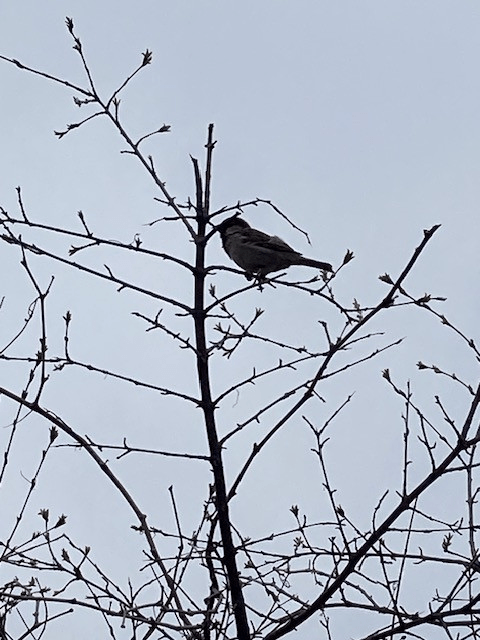
With the shift to Bluesky this April, I found myself using photos to accompany some of the poems, and this was a case in point. As spring arrived in earnest, I had added three photos to this post from a walk in the nearby park: one of new blossoms on a tree, one of a bird silhouetted against the morning sky, one of new flowers and leaves. All three had been welcome sights to me in recent days, at the time, and all helped support the quote from Rachel Carson’s The Sense of Wonder, which celebrates close observation of several striking moments in nature, including the arrival of spring after winter.
A flowering tree in springtime. A bird silhouetted against the morning sky. Blossoms and leaves in the spring.
Carson’s quote states: “There is something infinitely healing in the repeated refrains of nature: the assurance that the dawn comes after night, and spring after winter. Those who contemplate the beauty of the earth find reserves of strength that will endure as long as life lasts.”
While it seems somewhat melancholy to write about this particular poem in September, since the calendar is now shifting slowly back toward shorter days and cooler temperatures, the transition from summer to autumn provides its own welcome moments. I noticed over a recent weekend that the maple trees along the same path were just beginning to be tinged with red.
Maple leaves just beginning to reveal their scarlet autumn colors.
While these are not the new leaves of spring, their autumnal turns are always a highlight; their appearances, to borrow Carson’s wording, provide similarly healing refrains.
“In intro chem classes, find note on / Identification schemes rote: yon / Wall-chart periodic / Yields info methodic— / Sorts matter by number of protons!”
The 3 April 2025 limerick addressed the organizational scheme used on the modern Periodic Table of the Elements (PTE), which depends on a property called atomic number.
This limerick builds on the introductory theme of the PTE by adding a more direct explanation of how it is organized. The poem introduces how to interpret the PTE most usefully: that is, with a view towards “identification schemes rote” and other reliably predictable information that the table can provide.
“…Yon /Wall-chart periodic / Yields info methodic— / Sorts matter by number of protons!”
As seen last week, the PTE organizes chemical information in two dimensions (represented in the rows and columns of this famous grid).
Dmitri Mendeleev’s version of the PTE generally arranged elements in order of increasing atomic mass, which is the average weight of an element. However, he noticed that this trend, seen today in the rows, occasionally mismatched the elemental order with respect to chemical properties, seen today in the columns. In those aberrant cases, he leaned more heavily on the latter. Perhaps most famously, since he knew the patterns in both elements’ chemical behaviors and properties, he shifted tellurium, even though it had a slightly greater atomic weight, to be ahead of iodine in his ordering.
This confusion was remedied, building on the experimental findings of Henry Moseley, when the elements were instead numbered in terms of their atomic numbers, which represent the number of protons in atoms’ nuclei. In this case, tellurium has atomic number 52 and iodine has atomic number 53, so that their order is logical in both dimensions of the PTE (both row and column).
The modern PTE (the “wall-chart periodic”) provides a wealth of data (“info methodic”) and is arranged in order of atomic number (“sort[ing] matter by number of protons”).
“Begin here by setting the Table: / Collection of hist’ry, trends, labels. / On chem walls by way of / One D. Mendeleev: / As theme, it’s a STEM-poem staple.”
“Begin here by setting the Table: / Collection of hist’ry, trends, labels…”
The PTE compiles a wealth of information on the history of chemistry, periodic trends, and elemental labels.
I’ve used the adjective “table-set” in a different attempt at the NaPoWriMo routine, but this was the first time I’d used the idiom of “setting the table,” which I appreciated for its connection to beginnings, early in April. The capital T demonstrated that I meant the most famous of tables, in terms of how a chemist would generally see it!
“On chem walls by way of / One D. Mendeleev…”
Most science classrooms display the PTE: i.e., it’s generally found “on chem walls.” While its full story is complex and fascinating, the most direct precursor to our modern version of the PTE was published by Dmitri Mendeleev in 1869. (Given that I’ve written about his story multiple times, it was fun in this limerick to look for new rhyme opportunities and to find one with his last name.)
“As theme, it’s a STEM-poem staple.”
This is a common theme for an early-April limerick for me, across multiple NaPoWriMo routines; thus, it is a “STEM-poem staple.”
***
Many legends around the PTE’s initial construction have emerged; one that I find striking is that Mendeleev was a card player, who enjoyed a game called Patience, similar to Solitaire. The PTE’s ability to organize information in two dimensions (atomic mass and elemental properties, given Mendeleev’s original rationale; refined slightly in our current understanding) mirrors the way that these card games organize information according to two dimensions (suit and number). This aspect of the story gave rise to the title for this post.
“A new metric month-long ambition! / This seventh attempt at tradition, / With change in the scen’ry / In midst of new green’ry: / A first try as Bluesky edition.”
Classes are now off to their Autumn 2025 start here; with the academic year underway, I’ll return to my weekly posts, translating the poems from the previous April’s National Poetry Writing Month (commonly abbreviated NaPoWriMo).
“A new metric month-long ambition! / This seventh attempt at tradition…”
The first few poems in each NaPoWriMo are generally consistent in theme, especially the first, which simply sets out the month’s goal of writing thirty science-themed poems for the thirty days of April: a “metric month-long ambition.” Since I completed this routine for the first time in April 2019, the 2025 poems marked my seventh attempt.
“With change in the scen’ry / In midst of new green’ry: / A first try as Bluesky edition.”
The April 2025 poems constituted the first set that used Bluesky as the website for the original postings (“first try as Bluesky edition”); they thus reflected “a change in the scen’ry” in the midst of springtime’s “new green’ry.”
This particular poem is quite straightforward, so I’ll keep the word count short, for once. The new set of 2025-2026 essays will provide “August company” (as well as that of September and onward, throughout this new school year!) to the April 2025 poems.




 Chemphasis
You must be logged in to post a comment.