“For stories in wondrous locations; For resources; for inspiration; For questions advisory… We’re drawn to the library: A welcome site, found in translation.”
The 6 April 2025 Bluesky limerick celebrated the start of National Library Week with an allusion to a specific type of molecular motion called translation.
“For stories in wondrous locations; / For resources; for inspiration; / For questions advisory… / We’re drawn to the library…”
National Library Week generally runs in mid-April, so it often lines up well with April’s National Poetry Writing Month routine, as it did in 2025.
The poem’s first four lines celebrate the many ways I have found libraries to be welcome resources in the many places I’ve lived, over many years of teaching and learning; they house a wealth of books and resources, accompanied by librarians’ wide-ranging areas of expertise.
As in many of these previous April routines, I note that such a theme requires little explanation, relative to the typical chem poems; “libraries are great!” is a straightforward and celebrated concept.
“A welcome site, found in translation.”
The fifth line is the one that links National Library Week to a scientific theme.
In a chemistry context, translation means molecular motion in three-dimensional space (we can think of a molecule of oxygen sailing through an open room, for instance). Translation contrasts with vibration and rotation, the other two types of molecular motion, which involve internal motions of the molecule itself: stretching or compressing its bonds or spinning on its internal axes, respectively.
Since we travel geographically to a different location (“site”) when we go to the library, the library is “found in translation.” (I also liked the more hopeful contrast that this last image sets up with the common phrase of “lost in translation.”)
“An etymologic devotion Of abbreviational notion; ‘Hg’ as the symbol For metal most nimble: Quicksilvery liquid in motion.”
The 5 April 2025 Bluesky limerick was the first to focus on vocabulary, this spring; this type of theme ultimately would become a major focus of the second half of the month. In this particular case, the limerick celebrated one of the more unusual symbols on the periodic table of the elements (PTE), that of mercury (Hg).
The first two lines acknowledged the goal: celebrating the story behind a symbol from the PTE.
“ ‘Hg’ as the symbol…”
Mercury is the element represented by the chemical symbol Hg, which is short for “hydrargyrum,” which is such an unwieldy word that I’ve spell-checked myself twice in writing this sentence.
“Hydrargyrum” is the Latin name for the element mercury, stemming previously from the Greek “hydrárgyros.” Once we know that, we see more familiar roots: “hydr” comes from “water” and “argyrum” from “silver” (compare the latter to “argentum,” yielding Ag as a similarly non-intuitive abbreviation for silver).
“For metal most nimble: /Quicksilvery liquid in motion.”
As its water-themed etymology suggests, mercury is a liquid at room temperature and atmospheric pressure, setting it apart from the other metals, which are solids under these conditions. Mercury is the “metal most nimble.”
The Roman god Mercury was said to govern a range of areas, operating fleetly on borders between worlds and disciplines: commerce, communication, travel. The planet Mercury took its name from the god Mercury, given its speedy astronomical motion. The element mercury was named via a complex path through alchemical history that would take me well past 280 words. Quicksilver is an evocative nickname for mercury meaning “living silver,” reflecting its fascinatingly kinetic behavior. Another tangent I stumbled upon is that the word “amalgam” means an alloy (mixture of metals) involving mercury, specifically; I had previously seen those two terms as synonyms, erroneously.
I remain confident one could create a fascinating interdisciplinary course by asking students to investigate and decipher chemical jargon, rather than expecting it to be immediately processed and used, as most disciplinary classes require.
When faced with some ground-shifts dramatic, Keep eye on the view panoramic. When current aesthetic Seems “only kinetic,” Still aim for the thermodynamic.
I’m taking a break from revisiting April 2025’s poems to reflect on an excellent essay I read recently, written by Jonathan Malesic and published in The Hedgehog Review. Although my own teaching experience is in science, rather than the humanities, I found the piece to be insightful encouragement in beginning a new academic year.
One of the closing lines reminded me of a concept I’ve taught in organic chemistry coursework, which gave rise to this particular limerick. (I’ll allow myself some additional words here; this poem is not part of the NaPoWriMo routine, and it relies on a content-dense metaphor.)
When faced with some ground-shifts dramatic, / Keep eye on the view panoramic.
Briefly, Malesic’s essay reflects on the disorienting experience of teaching in the time of generative AI, which answers typical assignment prompts and content-related questions within milliseconds. (What’s more, the results of such processes are now often automatic top results with common search engines— thus, tough to avoid.) This innovation has required recent “ground-shifts dramatic” in terms of how assignments and evaluations are considered.
I became aware of Malesic’s piece after seeing the moving conclusion posted on social media in the days before my semester began. He writes, in part:
“Part of a teacher’s job—certainly in the humanities, but even in professional fields like business—is to help students break out of their prisons, at least for an hour, so they can see and enhance the beauty of their own minds… I will sacrifice some length of my days to add depth to another person’s experience of the rest of theirs. Many did this for me. The work is slow. Its results often go unseen for years. But it is no gimmick.”
I was struck by the mention of the timescale of what we aim to achieve in the classroom versus what the goals seem to students.
Those timescales are often unacknowledged for STEM; I’ve written here before about the frustrating contrast between my biggest syllabus goals (e.g., that an intro chemistry course will help teach critical thinking skills) and what’s actually assessed (narrowly defined chemistry content, often tested via “all-or-nothing” exam questions, such as true/false or multiple-choice). In the moment in the classroom, the focus is on specific, chem-centric concepts and calculations. Over the course of a lifetime (via a “view panoramic”), the goal is that graduates can confront complex real-world challenges and questions as they arise in and across a variety of subject-matter areas.
I acknowledge this tension much more now than I did in early years of teaching, but Malesic’s essay was a reminder of how much power is in the direct statement: “The work is slow. Its results often go unseen for years.”
When current aesthetic / Seems “only kinetic,” / Still aim for the thermodynamic.
In considering these relative timescales– the days/weeks of the semester vs. the years/decades of a lifetime– I was reminded of a concept from organic chemistry. The big ideas, generally stated, are these. Some chemical reactions reliably form multiple products. In these cases, chemists can manipulate reaction conditions to form one product preferentially. Overall, as a shorthand: the product that is faster to form is called the kinetic product, while the one that is more energetically stable is called the thermodynamic product.
For a quick example, see the image below (generalized as a case study from info at this link). The starting molecule at the left has two places from which a hydrogen atom (H) can be removed, resulting in the formation of a double bond: position A or position B. We would say position B is more sterically hindered (crowded), due to the presence of the methyl group (CH3) on that side of the molecule.
A generalized illustration of kinetic vs. thermodynamic control, where 2-methyl cyclohexanone reacts with a base to form two potential enolate products. While both products form in both reactions, Product A forms more often with a bulky base and at very low temperatures, while Product B forms more often with a non-bulky base at higher temperatures.
Both products form in both scenarios, but we can influence which product forms more often.
If we want to form Product A preferentially, we use a bulky base and run the reaction at very low temperatures. In that case, Product A is faster to form because the incoming base can more easily access the hydrogen atom on that less-crowded side. The low temperatures keep the reactions from reversing. This is ultimately a kinetic effect (involving the relative activation barriers), so we call Product A the kinetic product. Though it is not as stable long-term, it is faster to form in this scenario.
If we want to form Product B, we use a more compact base and run the reaction at higher temperatures. In this case, Product B will be more prevalent because its resulting double bond is more highly substituted in terms of attached alkyl groups, which lends the molecule more energetic stability overall. The high temperatures allow pertinent reactions to go back and forth until the product with greater overall stability is achieved. This is ultimately a thermodynamic effect (involving the relative equilibria of the products), so we call Product B the thermodynamic product. It is slower to form, but it is ultimately more stable over time.
***
All this (ALL this— thank you to anyone still bearing with me!) to say: the knowledge of a lifetime seems to be the ultimate thermodynamic product. Again, to Malesic’s point regarding the delay between the moment in the classroom and the payoff across the years, we cannot truly assess lifelong learning on a semester’s timescale.
That’s frustrating for both students and faculty, working within what can seem an “only kinetic” system, especially as technological shifts impact what assignments and assessments have been traditional indicators before. However, the long-term view, with its consistent “aim for the thermodynamic,” is helpful to keep in mind, as the fall semester moves into full swing.
“A shift both routine and elysian; / A blend between wonder and reason… / Past winter’s endurance, / Returning assurance: / Repeated relief of spring’s season.”
“A shift both routine and elysian; / A blend between wonder and reason…”
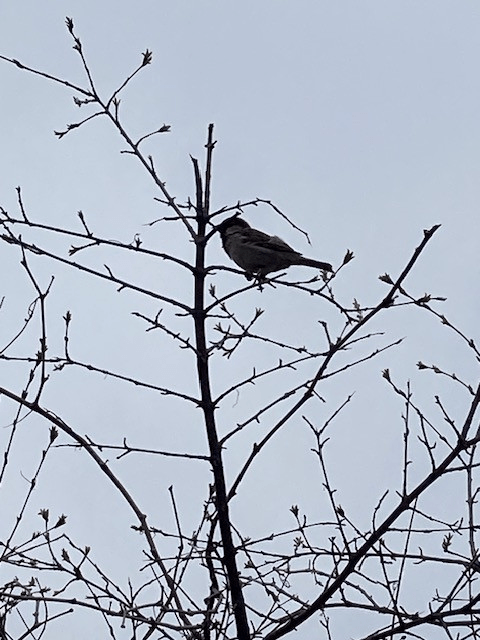
With the shift to Bluesky this April, I found myself using photos to accompany some of the poems, and this was a case in point. As spring arrived in earnest, I had added three photos to this post from a walk in the nearby park: one of new blossoms on a tree, one of a bird silhouetted against the morning sky, one of new flowers and leaves. All three had been welcome sights to me in recent days, at the time, and all helped support the quote from Rachel Carson’s The Sense of Wonder, which celebrates close observation of several striking moments in nature, including the arrival of spring after winter.
A flowering tree in springtime. A bird silhouetted against the morning sky. Blossoms and leaves in the spring.
Carson’s quote states: “There is something infinitely healing in the repeated refrains of nature: the assurance that the dawn comes after night, and spring after winter. Those who contemplate the beauty of the earth find reserves of strength that will endure as long as life lasts.”
While it seems somewhat melancholy to write about this particular poem in September, since the calendar is now shifting slowly back toward shorter days and cooler temperatures, the transition from summer to autumn provides its own welcome moments. I noticed over a recent weekend that the maple trees along the same path were just beginning to be tinged with red.
Maple leaves just beginning to reveal their scarlet autumn colors.
While these are not the new leaves of spring, their autumnal turns are always a highlight; their appearances, to borrow Carson’s wording, provide similarly healing refrains.
“In intro chem classes, find note on / Identification schemes rote: yon / Wall-chart periodic / Yields info methodic— / Sorts matter by number of protons!”
The 3 April 2025 limerick addressed the organizational scheme used on the modern Periodic Table of the Elements (PTE), which depends on a property called atomic number.
This limerick builds on the introductory theme of the PTE by adding a more direct explanation of how it is organized. The poem introduces how to interpret the PTE most usefully: that is, with a view towards “identification schemes rote” and other reliably predictable information that the table can provide.
“…Yon /Wall-chart periodic / Yields info methodic— / Sorts matter by number of protons!”
As seen last week, the PTE organizes chemical information in two dimensions (represented in the rows and columns of this famous grid).
Dmitri Mendeleev’s version of the PTE generally arranged elements in order of increasing atomic mass, which is the average weight of an element. However, he noticed that this trend, seen today in the rows, occasionally mismatched the elemental order with respect to chemical properties, seen today in the columns. In those aberrant cases, he leaned more heavily on the latter. Perhaps most famously, since he knew the patterns in both elements’ chemical behaviors and properties, he shifted tellurium, even though it had a slightly greater atomic weight, to be ahead of iodine in his ordering.
This confusion was remedied, building on the experimental findings of Henry Moseley, when the elements were instead numbered in terms of their atomic numbers, which represent the number of protons in atoms’ nuclei. In this case, tellurium has atomic number 52 and iodine has atomic number 53, so that their order is logical in both dimensions of the PTE (both row and column).
The modern PTE (the “wall-chart periodic”) provides a wealth of data (“info methodic”) and is arranged in order of atomic number (“sort[ing] matter by number of protons”).
“Begin here by setting the Table: / Collection of hist’ry, trends, labels. / On chem walls by way of / One D. Mendeleev: / As theme, it’s a STEM-poem staple.”
“Begin here by setting the Table: / Collection of hist’ry, trends, labels…”
The PTE compiles a wealth of information on the history of chemistry, periodic trends, and elemental labels.
I’ve used the adjective “table-set” in a different attempt at the NaPoWriMo routine, but this was the first time I’d used the idiom of “setting the table,” which I appreciated for its connection to beginnings, early in April. The capital T demonstrated that I meant the most famous of tables, in terms of how a chemist would generally see it!
“On chem walls by way of / One D. Mendeleev…”
Most science classrooms display the PTE: i.e., it’s generally found “on chem walls.” While its full story is complex and fascinating, the most direct precursor to our modern version of the PTE was published by Dmitri Mendeleev in 1869. (Given that I’ve written about his story multiple times, it was fun in this limerick to look for new rhyme opportunities and to find one with his last name.)
“As theme, it’s a STEM-poem staple.”
This is a common theme for an early-April limerick for me, across multiple NaPoWriMo routines; thus, it is a “STEM-poem staple.”
***
Many legends around the PTE’s initial construction have emerged; one that I find striking is that Mendeleev was a card player, who enjoyed a game called Patience, similar to Solitaire. The PTE’s ability to organize information in two dimensions (atomic mass and elemental properties, given Mendeleev’s original rationale; refined slightly in our current understanding) mirrors the way that these card games organize information according to two dimensions (suit and number). This aspect of the story gave rise to the title for this post.
“A new metric month-long ambition! / This seventh attempt at tradition, / With change in the scen’ry / In midst of new green’ry: / A first try as Bluesky edition.”
Classes are now off to their Autumn 2025 start here; with the academic year underway, I’ll return to my weekly posts, translating the poems from the previous April’s National Poetry Writing Month (commonly abbreviated NaPoWriMo).
“A new metric month-long ambition! / This seventh attempt at tradition…”
The first few poems in each NaPoWriMo are generally consistent in theme, especially the first, which simply sets out the month’s goal of writing thirty science-themed poems for the thirty days of April: a “metric month-long ambition.” Since I completed this routine for the first time in April 2019, the 2025 poems marked my seventh attempt.
“With change in the scen’ry / In midst of new green’ry: / A first try as Bluesky edition.”
The April 2025 poems constituted the first set that used Bluesky as the website for the original postings (“first try as Bluesky edition”); they thus reflected “a change in the scen’ry” in the midst of springtime’s “new green’ry.”
This particular poem is quite straightforward, so I’ll keep the word count short, for once. The new set of 2025-2026 essays will provide “August company” (as well as that of September and onward, throughout this new school year!) to the April 2025 poems.
Some big-picture points metaphoric And mentions of themes allegoric; The past-tense adjourning to Present-tense learning, through Look back at chem, set historic.
In this last July 2025 essay, as I note the imminent autumn semester, it’s a constructive exercise to connect some of this summer’s posts to the year ahead, aiming to build on some of these points in teaching.
Some big-picture points metaphoric / And mentions of themes allegoric…
Rediscovering “the hedgehog and the fox” in their artistic context this summer has provided a welcome chance to reflect on some images and readings I’ve found illustrative in my career. It’s also a helpful reminder to consider some “big-picture” points that would have helped me as a student to see directly stated within my home discipline of chemistry, such as the following.
The considerations of what introductory chemistry courses should include are complex and change with time; they are updated every few years based on the careful recommendations of experts in the field. This variation with time is also seen with general education science coursework. An undergraduate student’s curriculum at the university level does not aim solely to maximize content covered in a single field but involves a complex optimization of coursework and logistics across campus.
The history of science is not typically part of a science-specific textbook; the expectation in an intro-level science course is generally that complex disciplinary content will be covered comprehensively to prepare the majority of students, who are non-majors, for future standardized exams and courses in their professionalprograms. (Introductory science courses are often classified as “service courses” because of this, since departments teach such courses in part as a service to other programs.)
Story is a powerful medium for communicating scientific information but also one that presents concerns for many scientists. Translating jargon and learning standardized vocabularies are challenging, important parts of science coursework; these underlying language-learning steps are not often presented with the commentary or scaffolding that disciplinary concepts and calculations are.
Biographies of the scientists whose findings supported pertinent concepts are readily available and can often help illustrate those concepts. Likewise, memoirs of scientists are often superb chances to read about the processes of science, with challenges and benefits detailed in ways not seen in journal articles or textbooks.
The past-tense adjourning to / Present-tense learning, through / Look back at chem, set historic.
I should always emphasize that these are my own takeaways from a career in teaching chemistry, directly distilled into the points and acknowledgements that would have helped me most, personally, as a science student, many years ago. I’m confident that anyone looking back at their own path would find their own set of illuminating moments and sources. However, it has been useful at times to take stock of such material, and looking to the start of the fall semester, with its “present-tense learning,” seems a logical time to do so.
Speaking of that timeline, I’ll give myself a few weeks now to let said semester start up, then return to the “translation” essays for the poems I wrote during April 2025, over the course of the next academic year.
In tandem with themes sci-artistic, The knowledge of hurdles logistic; Curriculum-spanning In course-schedule planning: More prosaic characteristics.
After acknowledging many benefits of interdisciplinary endeavors and learning, my next essay in July 2025 shifts to some of the inherent challenges in such efforts, building on some of the knowledge I gained through a recently completed academic role.
In tandem with themes sci-artistic…
I finished a five-year term of directing an interdisciplinary general education program, just a few weeks ago. I greatly appreciate this program because of my interest in “themes sci-artistic” (i.e., interdisciplinarywork), and I consider myself extremely fortunate to be on a campus that offers such classes. That being said, it also was instructive over the past few years to see how learning goals intersect with logistical realities, at the university level.
The knowledge of hurdles logistic; / Curriculum-spanning / In course-schedule planning…
The central technique from my own computational chemistry research is that of a geometry optimization, a calculation that searches for the best values for the bond lengths and angles in a given molecule, considered by evaluating the resulting energy of that molecule, looking for the optimal geometry over several iterations (attempts). More broadly and metaphorically, it can be characterized as searching for the best possible combination of a number of complex, intersecting variables.
Such an endeavor translates well to curriculum planning: optimizing which classes are offered when, via what variety of departmental contributions, to meet the curricular needs of the greatest number of students. As with computational chemistry, multiple attempts are needed to get to the best possible “structure”: in this case, via a wide array of conversations.
This curricular optimization (“curriculum-spanning in course-schedule planning”) also spotlights some of the hurdles to interdisciplinary cooperation. For instance, many departments rely on Tuesday-Thursday schedules, and many others on Monday-Wednesday-Friday schedules, for their most common courses. More interactive classes like laboratories and studios require lengthy blocks of time that create unusual conflicts across student and faculty schedules. The course schedule then impacts all other aspects of academic life: what times are available for research; who can contribute to a given committee; etc.
Truly collaborative inquiries require the expertise of researchers from multiple disciplines, whose teaching responsibilities generally correspond to multiple departments. Thus, while such collaborations are undeniably laudable goals, pursuing them in an academic setting requires an awareness of several dimensions at once.
More prosaic characteristics.
Compared to conceptual interdisciplinary overlaps, these logistical conversations are more prosaic. However, I’ve found them fascinating as well, as I’ve seen them up close. The idea of curricular “optimization” as an ongoing, iterative process is helpful; each academic year is a chance to aim for a slightly better-laid plan, while acknowledging the immense complexity of the underlying structure.
In further cross-discipline striving Of breadth-versus-depth enterprising, Past mys’tries, detailing Through lens countervailing: Find insights routine yet surprising.
I was fortunate to double-major in both chemistry and English as an undergraduate. At that time, paleontologist Stephen Jay Gould was the primary science essayist of whom I was aware, as his work had been excerpted in several of the anthologies I read as part of my English courses. I then received The Hedgehog, the Fox, and the Magister’s Pox as a Christmas gift early in my graduate school career, soon after I had narrowed my academic path to chemistry.
Throughout my academic path, Gould’s book has been a helpful reminder of the broader interdisciplinary context in which I remain most interested.
In further cross-discipline striving / Of breadth-versus-depth enterprising…
As alluded to in the last post, Gould’s final book surveys “breadth-versus-depth [“fox versus hedgehog”] enterprising” throughout some key episodes in the history of science. It was a challenging read, initially. When I first read it, I was still developing my fluency in chemistry. My discipline, moreover, was far afield from Gould’s expertise in natural history, which provided his own lens into studying the history of the sciences and humanities. Finally, given that my own interests had been supported by both of my home departments during my undergraduate work, I had not yet encountered academic tension between the fields in the way Gould describes.
However, this was a book that acknowledged and embodied the fact that investigations at the borders between academic disciplines exist, and it described some phenomena I would soon come to see in my own career. Contextualizing such observations has ultimately been quite helpful in my long-term academic path. I have come back to Gould’s text often, finding new insights in each instance of “cross-discipline striving.”
Past mys’tries, detailing / Through lens countervailing…
Gould’s book provides a survey of scientific history that is broader than what is included in science-specific textbooks (at least in my experience). He first describes the context of the Renaissance as the re-birth of the interest in classical knowledge, a movement which formed the basis of what we now consider the humanities, and he highlights the complexity of how that time period intersects with the Scientific Revolution, with new emphasis on experiment and the scientific method. He reads scientific texts from past centuries, using his training from the humanities to read them closely in their historic context, and he acknowledges that this is a fundamentally different technique than scientists use in surveying their disciplinary literature when working on an experimental research question.
These broad points would’ve been extremely helpful with a distractingly key question I had as a science student: why was the language in science textbooks functioning so unusually, compared to my experience with other books? I still find it striking that the first text I encountered that specifically addressed such a topic used the “lens countervailing” of a non-science-specific viewpoint. (One of the things I’ve appreciated most about Gould’s book is the way it opened the door to additional reading, which I’ll come back to in a future post, but the word count here is already excessive, even for a summer essay.)
Find insights routine yet surprising.
Interdisciplinary fields such as the history of science, the philosophy of science, and science communication are well-established. I am aware that what I have found to be surprising realizations throughout my narrower, chemistry-specific career path constitute routine knowledge to scholars in these areas! I do think, though, that contextualizing points do have immense capacity to stand out to students in a given chemistry lesson, and as such, I have found it rewarding to supplement my chem-textbook-centric presentations with some of this broader information, over the past several years.




 Chemphasis
You must be logged in to post a comment.