Categories
Science Poetry

Blue Skies

“A morning’s song from bird-soprano,
In tree-set melodic crescendo;
The view, reminiscent 
Of project long-distant,
Past print in a type of cyano.”

The 20 April 2025 limerick highlighted a memorable spring morning sight, linking it to a past “chemistry in art” project.  

“A morning’s song from bird-soprano, /
In tree-set melodic crescendo…”

Part of what I enjoy about the April poetry routine is that it also corresponds with a return to regular morning walks, after winter’s unpredictability.  Spring weather is always a help.  (I’m writing this particular post in the wake of a massive snowstorm and scheduling it for next month; I imagine the relief in 2026 will be particularly pronounced!)  

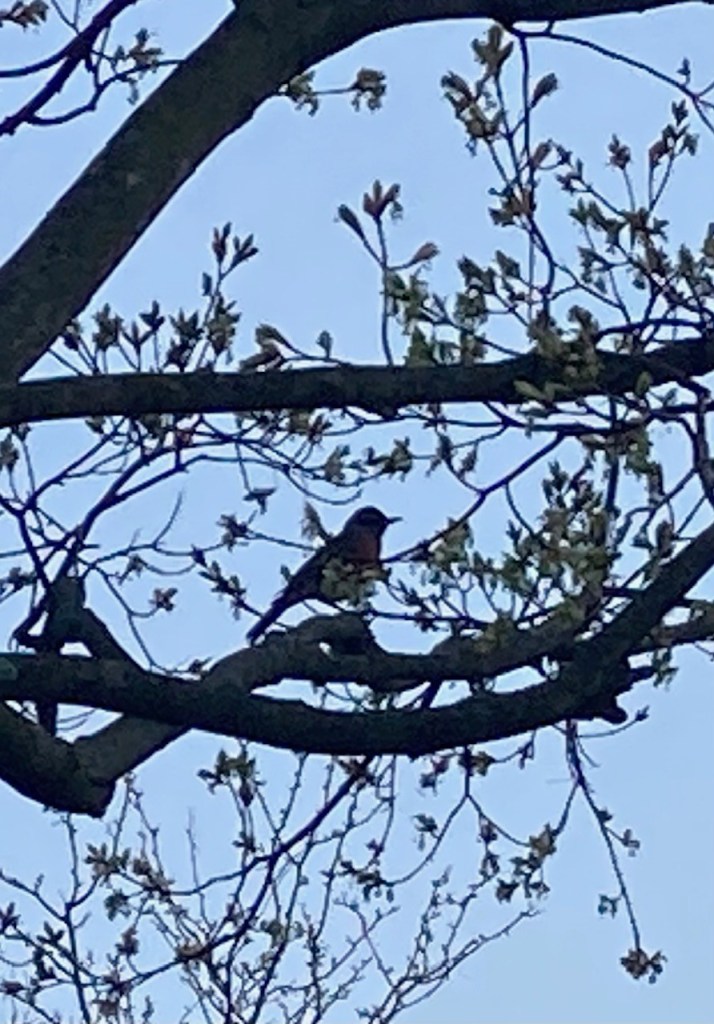
Last year, I took this photo during an early Sunday hike; I heard the bird’s song and then found it in the midst of a flowering tree.  

A photograph of a small bird sitting on a tree branch in the midst of blossoms. 

A photograph of a small bird sitting on a tree branch in the midst of blossoms.  

“The view, reminiscent /
Of project long-distant, /
Past print in a type of cyano.”

The scene last April had reminded me of one of my earliest (“long-distant”) cyanotype attempts, used to illustrate a much-earlier April poem, translated in a much-earlier April post

I had used a simple stencil with commercially available photosensitive paper, which is a far cry from what actual cyanotype artists do. However, it was still a striking image. I particularly enjoyed how the visual effects reversed between the cyanotype (where the bird was lighter than the background) and the April 2025 photo (where the bird was silhouetted against the sky).        

A cyanotype print in which the characteristic deep blue background contrasts with an image of a small bird sitting on a tree.

A cyanotype print in which the characteristic deep-blue background contrasts with an image of a small bird sitting in a tree. 

With the last line, I had originally written “Past print in a tint of cyano,” to achieve the internal rhyme. I ultimately decided that, for something standing on its own on Bluesky, it made sense to more directly cite the technique.  

Cyanotypes were pioneered by Sir John Herschel (whose scientific accomplishments are many!) and popularized by Anna Atkins, among others, during the 1800s.     

Categories
Science Poetry

To the Letter

“Element-naming:
Consider potassium,
Alkaline nature seen
Back in the day.  
Saga through history:
Named after potash;
The Latin form, ‘kalium’;
Symbol is K.”  

The 19 April 2025 Bluesky poem featured the last of the week’s etymologic tributes.  It celebrated a theme I’ve examined before, that of an unusual element abbreviation; in this case, the element of interest was potassium.  

“Element-naming: /
Consider potassium…”

As with sodium, highlighted here a while ago, this story told through this poem can become circular.  It will ultimately link potassium with its non-intuitive chemical symbol, the letter K. 

(Like the last few essays, the inspiration for this poem and post were derived ultimately from Isaac Asimov’s Words of Science and the History Behind Them.)       

“Alkaline nature seen /
Back in the day. /
Saga through history: /
Named after potash…”

Potassium is an alkali earth metal; it is placed in Group 1A on the Periodic Table of the Elements (PTE), and its compounds exhibit alkaline (basic) behavior.  The term alkali, in turn, is derived from “al qaly” in Arabic, reflecting the plants from which such substances were found (that is, the plants in question were found near the qaly (saltwort)). 

Asimov notes that ashes of these plants (the “pot ash”) could be used to form an ingredient in making an effective soap.  Potash is now recognized as a combination of ionic salts with potassium acting as the common cation.    

“The Latin form, ‘kalium’; /
Symbol is K.”  

Potassium was one of the elements identified conclusively by Humphry Davy via electrolysis in 1807.  Because it was isolated ultimately from pot ash, Davy at that time named it potassium.  German chemists, in experiments with and observations of the same element around the same time, deemed it kalium, based on the Latin word.

This difference persists today!  The English-language version of the PTE today reflects both influences, with symbol K and name potassium.  The German-language version of the PTE lists the name for potassium as kalium and denotes element 11 (sodium) as natrium (Na), clarifying the relationship between name and symbol.  

Categories
Science Poetry

Same, Difference

“Same atoms; distinct connectivities:
Two isomers’ key descriptivities.  
With ‘parts being equal,’
Second structure’s a sequel
To first, in atomic vicinities.”

The 18 April 2025 limerick continued the week’s focus on scientific vocabulary, this time via a chemistry-specific term: “isomer.”  

“Same atoms; distinct connectivities: /
Two isomers’ key descriptivities.”    

For students taking Organic Chemistry, a common early learning goal involves the classification of two given molecules as structural isomers or stereoisomers (or neither). 

Structural isomers are also called constitutional isomers; these are molecules with the same molecular formulas (same number of each type of atom) that differ in the order that the component atoms are connected. In stereoisomers, both the molecular formulas and the connection orders are the same, but the three-dimensional arrangements of the atoms differ.  

Each of the major classifications here involves several more subcategories (i.e., tautomers, enantiomers, etc.), each of which takes much time to visualize and learn.  Learning these nuances is generally enough work that we do not further delve into the etymologies of the terms, but those can be nonetheless fascinating.       

“With ‘parts being equal,’ /
Second structure’s a sequel /
To first, in atomic vicinities.”

In his 1959 book Words of Science and the History Behind Them, Isaac Asimov explains that, in 1830, chemist Jöns Jakob Berzelius noted the increasing number of situations in which new compounds were being discovered that had the same molecular formulas but different properties.  Berzelius suggested the name isomers to distinguish these cases from one another: iso from the Greek for “equal,” and mer from the Greek for “parts.”  

The poem celebrates the fact that while the numbers of component atoms in two isomers would be the same, the “atomic vicinities” within those isomers would differ.   

As with much chemistry vocabulary, “isomer” was a word I had used for many years without truly considering its origin, until last April’s poetic routine. 

Categories
Science Poetry

Temperature Gauge

“A read of the term here is literal: 
‘One hundred steps’ seen in the interval 
From boil to freeze  
As we scale the degrees 
In the temp’rature’s centigrade water-fall.”

The 17 April 2025 limerick again built on information I learned from Isaac Asimov’s 1959 book, Words of Science and the Histories Behind Them.  This particular poem commemorated the Latin roots of the word “centigrade.”       

“A read of the term here is literal…” 

Many temperature scales exist and are useful in different contexts.  Several are named for the scientists who devised them, such as Daniel Gabriel Fahrenheit; William Thomson, 1st Baron Kelvin; and Anders Celsius.     

“One hundred steps’ seen in the interval /
From boil to freeze / 
As we scale the degrees /
In the temp’rature’s centigrade water-fall.”

The Celsius scale was known first as the centigrade scale.  A temperature scale is defined via two reference points.  Anders Celsius proposed in 1742 that a new scale be defined, with water as the reference material: zero could be used for the boiling point and 100 for its melting point.  He further proposed one hundred steps between them, using the term “centigrade” to denote this (“centum” means “one hundred” in Latin; “gradum” means “steps”).  

The two references were ultimately reversed, and the scale was renamed in 1948 in Celsius’s honor.  Thus, in our current experience, 0 °C now represents the temperature at which ice melts to form liquid water, and 100 °C represents the temperature at which liquid water boils to form steam.  

The Celsius scale is closely related to the Kelvin scale: for instance, a difference of ten degrees Celsius would be equal to a difference of ten Kelvin.  The Kelvin is the SI (International System of Units) unit of temperature, and its scale extends to absolute zero: 0 K, or -273.15 °C.  Temperatures expressed in degrees Celsius can be easily converted to Kelvin by adding 273.15. (Because the Kelvin scale is absolute, SI convention states it does not use the “degree” sign or notation.)  

Categories
Science Poetry

Sky Lights

“Read past-astronomical ponderings,
Ideas of odysseys, conjuring. 
Stars: fixed in the sky,
But some objects move by–
The planets, so deemed for their ‘wandering.’” 

The 16 April 2025 Bluesky limerick was another that built on the etymology of a common scientific term, from Isaac Asimov’s Words of Science and the Histories Behind Them.  In this case, the term in question was “planet.”  

“Read past-astronomical ponderings, /
Ideas of odysseys, conjuring.”  

Throughout ancient history, seven lights could be seen to travel more seemingly-randomly across the sky, rather than making the consistent patterns that the stars did.  (Asimov notes that the latter are sometimes called the “fixed stars” for this reason, since constellation shapes do not change.) These seven entities that underwent comparative “odysseys” are now known as the Sun and the Moon, and as Mercury, Venus, Mars, Jupiter, and Saturn. 

“Stars: fixed in the sky, /
But some objects move by– /
The planets, so deemed for their ‘wandering.’”       

Writing about these etymologies in more detail sometimes seems strangely circular (should I describe those five planets as such, in the expanded prose, before the word is officially introduced in the poem?). In this case, the last line finally links the term of interest to its original Greek derivation, since planetes means “wanderer.”  Looking up the current definition reveals considerable additional precision now used with the term “planet,” from centuries of astronomical use.  

It is also interesting to consider the long shadows that these seven historical observations cast on our calendar.  The seven-day week was established during the time of the Roman Empire, building on much more ancient traditions.  It’s possible to link the name of each of the seven historically-observed heavenly bodies to a current day of the week, via several mythological equivalencies and subsequent translations.  The sun and moon are evident in Sunday and Monday, respectively; Tuesday links ultimately to Mars; Wednesday, to Mercury; Thursday, to Jupiter; Friday, to Venus; and Saturday, to Saturn.   

Categories
Science Poetry

Building Blocks

“A building-block term first-admissible; / 
To everyday vision, invisible, /
The atom in logic /
Most etymologic /
Takes name from the Greek: ‘indivisible.’” 

The 15 April 2025 Bluesky poem explored the etymology for the word “atom.”  As noted last week, this essay and the next few will build primarily on the information from Isaac Asimov’s Words of Science and the History Behind Them, written in 1959.     

“A building-block term first-admissible; / 
To everyday vision, invisible…”

In chemistry, we see atoms as the “building blocks” that lead in their combination to chemical compounds.

The vocabulary term atom has an intriguingly complex history, originating millennia ago in classical history with the Greek philosophers Leucippus and Democritus.  They postulated the existence of tiny particles making up all materials, far beyond limits of “everyday vision,” and deemed these atomos, for “indivisible” or “uncuttable.”  

In some ways, their discussions seem unusual today.  Leucippus and Democritus thought that the properties of different materials would depend on the shape of the atoms: for instance, that hot and cold substances derived their hotness and coldness from their component atoms’ shapes.  However, the idea of everyday materials consisting of unseen, tiny pieces (also discussed in ancient philosophies elsewhere in the world) was itself a major insight.     

“The atom in logic /
Most etymologic /
Takes name from the Greek: ‘indivisible.’” 

When John Dalton proposed his atomic theory centuries later, he used this Greek term.  He stated that each element was composed of a unique type of atom: i.e., an atom of carbon would be fundamentally distinct from an atom of gold.  His use of the Greek term was logical in terms of his understanding of the atom at the time (“logic/ most etymologic”), as the smallest possible piece of matter. 

The current understanding of matter involves tinier pieces still: chemists consider the atom as consisting of protons, neutrons, and electrons, while physicists would discuss even smaller constituent parts.  

This link, from the blog Compound Interest, provides a superb visual overview of what scientists have meant by the word “atom,” from Dalton’s 1803 theory onward.    

Categories
Science Poetry

Close Reads

“Intro classes’
Sweeping natures:
Learn AND speak
The nomenclatures!  
Some, acknowledged;
Many, hid;
Closer reads can 
Build a bridge.”  

As I begin a new semester this week, it’s a good time to bring back the NaPoWriMo2025 translation routine. 

This poem was posted on 14 April 2025 on Bluesky and kicked off a week in which I explored the etymology behind several scientific terms, as detailed in Isaac Asimov’s fascinating book Words of Science and the History Behind Them, published first in 1959.  

Asimov’s book delves into the history behind several terms from physical science, providing space and context for a perspective broader than what is typically used in an introductory course.  I remember wishing for something like his book as a student (and yet am not terribly surprised that it took me this long to find it as a faculty member).     

“Intro classes’/
Sweeping natures: /
Learn AND speak /
The nomenclatures!”

In an introductory science course, students are learning the vocabulary (the “nomenclatures”) and simultaneously applying the vocabulary via complex problems, case studies, and lab experiments.      

“Some, acknowledged; /
Many, hid…”

Chemical nomenclature (or “IUPAC nomenclature,” where IUPAC stands for International Union of Pure and Applied Chemistry) is a massive endeavor in itself: a standardized, self-consistent naming scheme whereby any chemist can write a name for a compound that another chemist can interpret.  

Although it is the most obvious and “acknowledged,” the IUPAC naming scheme is just one of many nomenclatures introduced in an introductory chem course. 

The idea of familiar words’ taking on increasingly precise meanings in a scientific context (e.g., “base, “aromatic,” “resonance”); the need to be fluent with interpreting and writing scientific notation; the unusual vocabulary underlying scientific history, with so many “strange terms to fit the strangeness of the thing”– each of these goals constitutes to an extent its own language-learning challenges.  

Thus, many vocabulary goals in an introductory course, while similarly crucial, are comparatively “hid[den],” compared to the formal, disciplinary nomenclature.         

“Closer reads can / 
Build a bridge.”  

Asimov notes, in his book’s introduction: “Entering the world of mathematics and science turns into a meeting with a whole realm of new words… The scientific vocabulary is the bridge by which we enter the land, not the wall that keeps us out.”  

This theme appeals greatly to me, as someone interested in both chemistry and language, and it was fun last April to devote a week of poems to structuring verses around some of the definitions Asimov recounted.  I similarly look forward to revisiting them here.    

Categories
Science Poetry

Halfway Point

“With notes, marginalia, daydreaming—
Scrap paper as palette now seeming.  
The lim’rick, non-thwartive:
A format supportive
In April’s routine, still-esteeming.”  

The 13 April 2025 limerick celebrated the NaPoWriMo writing routine itself, and it seems a fitting place to pause these posts at the end of the Autumn 2025 semester.  

“With notes, marginalia, daydreaming— /
Scrap paper as palette now seeming.”  

The first two lines here commemorate the fact that NaPoWriMo has become steadily more familiar, as an academic-year tradition.  

Nearing April each year, I aim for a starting set of four or five poems; this is part of why I repeat some themes most years.  (At my preparatory extreme, in 2019, I made sure to have a set of thirty limericks written before I began, although what I ended up posting in that first go-round included some more spontaneous contributions.  This was admittedly excessive!)  

In more recent years, I’ve trusted myself to have “enough” inspiration to get through most of April in an ad hoc manner.  I thus often find myself jotting down rhymes in the margins of class prep notes or on scrap paper, throughout the month. 

“The lim’rick, non-thwartive: /
A format supportive /
In April’s routine, still-esteeming.”      

In the years when I have reconsidered trying NaPoWriMo, knowing I was headed into a hectic spring, I have found intriguing rhymes that lend themselves to the AABBA structure within the day.  The limerick form is “supportive” and “non-thwartive”; it provides creative adrenaline, allowing me to find interesting inspirations when I’d otherwise feel like I’m running on fumes.  

(A sidenote that hadn’t come to mind previously: I suppose that having April 2020 as my second NaPoWriMo attempt will forever cause subsequent “hectic” Aprils to pale in comparison, realistically.) 

*** 

And with that, I’ve reached the end of my scheduled Autumn 2025 posts and the end of autumn classes.  I may post occasionally over winter break here; if not, I will resume the NaPoWriMo2025 translations when we all reach 2026. 

Categories
Science Poetry

Conversation Piece

Creative, complex education, /
Socratic in STEM information /
With goals pedagogic  /
Through mode dialogic: /
The art of a chem conversation.  

This (non-NaPoWriMo) poem is inspired by a biography I encountered earlier this autumn: that of Jane Haldimand Marcet (1769-1858), who wrote a landmark chemistry textbook, Conversations on Chemistry.  First published in the early 1800s, the book was used throughout the century and inspired several generations of aspiring scientists.    

“Creative, complex education, / 
Socratic in STEM information…”

Jane Marcet’s 1806 work was entitled Conversations on Chemistry: In Which The Elements of That Science Are Familiarly Explained and Illustrated by Experiments.  

In the book, a teacher named Mrs. Bryant works through several complex chemistry concepts with her two students, Emily and Caroline.  Due to the question-and-answer format (“Socratic in STEM information”), the presentation is quite readable, even centuries on.  

I enjoyed this frank and clarifying acknowledgement of the way changing definitions can frustrate students; here, Caroline is first thinking of “elements” as only the classical four:  

CAROLINE: “Yes; I know that all bodies are composed of fire, air, earth, and water; I learnt that many years ago.”  

MRS. B.  “But you must now endeavour to forget it. I have already informed you what a great change chemistry has undergone since it has become a regular science. Within these thirty years especially, it has experienced an entire revolution, and it is now proved, that neither fire, air, earth, nor water, can be called elementary bodies. For an elementary body is one that has never been decomposed, that is to say, separated into other substances; and fire, air, earth, and water, are all of them susceptible of decomposition.”  

Quote from Jane Marcet’s Conversations on Chemistry

While this book was published a few decades before Dmitri Mendeleev’s periodic table (in 1869), the current understanding of “element,” as a substance that cannot be broken down into simpler substances, is evident in Mrs. Bryant’s discussion.

“With goals pedagogic /
Through mode dialogic…”

Marcet’s goal in writing her text was that it would teach chemistry to a wider audience, including female students and all students who would not have had access to formal education at the time (where traditional lectures would be the favored format).   

She was successful.  Her use of accessible language and familiar phenomena to describe science concepts was a ground-breaking step in science education.  Her chemistry textbook reached wide audiences and received multiple reprintings (although she was not credited as the author for the first several editions).  It was translated into several languages.  Seven years after Marcet’s death, the first lab-based science course taught to women in the United States of America (in 1865 in Boston) would use her book in its curriculum.                   

“The art of a chem conversation.”  

Marcet anticipated several trends in terms of today’s work in chemical education.  Current science communication efforts often build on exchanges wherein challenging points can be clarified through conversations (such as a co-hosted podcast or a social media video).  The idea of “flipping the classroom” aims to allow more interactive science learning, beyond lecture alone.    

***

Two notable asides, here:

First, although I had not heard of Marcet herself until this autumn, her life and work intersected with those of two names I knew quite well already.  Marcet was inspired to write her book after observing Sir Humphry Davy’s famous demonstrations and realizing that discussions afterwards were what helped her truly understand the underlying chemistry concepts.  Years later, Michael Faraday would begin his scientific career as one of Davy’s assistants at the Royal Institution, then ultimately contribute huge insights to the fields of chemistry, physics, and science education on his own.  Faraday had initially discovered his interest in electricity while working as an apprentice to a bookbinder… because one of the books that came into the shop happened to be Marcet’s text!   

Second, I found it fascinating that one of Marcet’s friends was Mary Somerville, likewise famous for writing a 19th-century text that engaged with its scientific subject matter in a creative way, building on accessible examples (On the Connection of the Physical Sciences).  Several clarifying illustrations and insights can be imagined in their conversations, as well. 

Categories
Science Poetry

Meta-Directing

Organic chem mem’ries retrievable;
Exam prep for STEM goals achievable:
Two varied texts, choosing
In weekend’s perusing;
Reflections on texts… inconceivable!  

This is a non-NaPoWriMo poem that has been on my mind as we near the autumn term’s final exams, based on my recollection of studying for my own exams many years ago.  I’ll give this a bit more flexibility with word count, given the scope of time covered.   

Organic chem mem’ries retrievable; /
Exam prep for STEM goals achievable: /
Two varied texts, choosing…

I found Organic Chemistry to be a challenging-yet-rewarding subject, which was an appealing combination for me as a student.  I would often spend a long stretch of a given weekend day in a study room at the library with my organic textbook and solutions manual, practicing as many problems as I could.  To provide a break, I often would grab a non-textbook novel from the library’s stacks, as well.  

In weekend’s perusing…

One weekend, the book I chose was William Goldman‘s The Princess Bride; I had seen the classic movie growing up, and it had been a great favorite of mine for many years.  However, I had not yet read the novel, and I was pleasantly surprised to find that it was likewise wonderful.  

I had so much fun reading through Goldman’s central conceit of an “abridged version” of a wordy historical text by original (fictional!) Florinese author S. Morgenstern.  Goldman’s asides throughout the book frame his creative narrative as one that his Florinese-fluent father originally created by skipping over the boring parts in “Morgenstern’s text” as he read aloud to Goldman, and that Goldman then committed to written text a generation later.  

This opened up a new type of writing for me, which I enjoyed as I took (increasingly common) breaks from studying electrophilic aromatic substitution in my chem books.  I had learned about metafiction in an excellent Literary Studies course the previous autumn, but it was a different type of discovery to find such a book on my own.  

Reflections on texts… inconceivable!  

At that moment, it felt like I was shifting between two extremely contrasting texts, and that of course is not incorrect.  A STEM textbook and a fiction classic are from decidedly different genres.  

When remembering it this autumn, though, I found it also intriguing to think of the similarities between the two books.  Any science book is itself also somewhat of an abridgement (as well as a bit of a speedometer): reflecting intentional choices from the author at the exact time of its writing, as well as much cut material from a complex history.  

In particular, Goldman has a wonderful aside at one point about how he is going to sum up one densely satirical Morgenstern-penned chapter with his father’s simple summary, which is much more germane to the narrative flow: “What with one thing and another, three years passed.”  It’s a phrase that has come to mind multiple times when I’ve provided a sweeping overview of some scientific theory, leaping among decades and centuries (excising FAR more than three years at a time!), in the space of a PowerPoint slide.  

“Inconceivable” is both an acknowledgment that I could not realistically have seen this similarity in the moment, many years ago, and (more directly) an homage to villain Vizzini’s famously oft-repeated characterization of unexpected plot developments in The Princess Bride’s book and movie.  

*** 

To add a few more words past the poem translation itself, looking into one of those long-persistent vocabulary questions for me: the “meta” of electrophilic aromatic substitution reflects a specific pattern of how functional groups are attached to a cyclic ring.  However, the “meta” of metafiction reflects a genre that is writing intentionally about writing, similar to how metacognition is thinking intentionally about thinking.  “Meta” in a chemistry context has always seemed an outlier.    

I can imagine a hand-waving hypothesis as to how the chem meaning gets there now, as “meta” itself comes from the Greek for “following.” “Meta-directing” is a category generally presented in a secondary way, in Organic Chemistry: it typically comes up as a contrast to a previously-introduced category called “ortho/para-directing.” I don’t think straining for such a connection would’ve helped me much as a student, though.  Moreover, following up after a more targeted search (having more of a sense now of where to look, many years later) I am not surprised to see that experts suspect a more retroactive and perhaps-arbitrary assignment of terms.  

However, electrophilic aromatic substitution (with its focus on ortho, meta, and para pathways) was indeed the organic mechanism I was studying during that long-past winter weekend, a fact which is itself motivation enough to use this post title.