Categories
Science Poetry

Grasping for Breadth

Defying the process-themed label; /
Support in the times far from stable: /
A semblance is seen /
Of a structured routine. /
We turn the next card on the table.  

As I reach a slightly calmer week with Spring Break, I’ve been thinking again about the excellent essay from The Hedgehog Review that I referenced a few months ago.  It’s worth requoting the eloquent conclusion that stood out to me in August and has been coming to mind throughout this 2025-26 academic year:    

“Part of a teacher’s job– certainly in the humanities, but even in professional fields like business– is to help students break out of their prisons, at least for an hour, so they can see and enhance the beauty of their own minds.  It is to help them learn, together, to defend how they want to live, precisely because they, too, unlike a machine, will one day die. I will sacrifice some length of my days to add depth to another person’s experience of the rest of theirs.  Many did this for me.  The work is slow.  Its results often go unseen for years.  But it is no gimmick.”  

Jonathan Malesic, in “ChatGPT Is a Gimmick,” in The Hedgehog Review

Throughout the year, I’ve been reflecting on the parallel structure of a science class meeting, knowing that our default course is not a discussion-based seminar but a content-driven lecture or lab. In other words, thinking of this “zeroth,” inherent ability of a humanities course to engage students in genuine and meaningful discussion, is there a comparably fundamental goal in a content-heavy science class?

Modeling how to approach calculations; working through derivations; trouble-shooting an experiment– these are narrower skill sets that defy the intentionally larger discussions that Malesic references. While I enjoy the sense of zooming out to talk about the role of science within society or the historical context of a discovery, it’s more common in my experience that such broader discussions happen in office hours, via research mentoring, or even with random questions in the hallway. 

That said, the specific approaches and techniques we teach in a science curriculum are likewise intended to be foundational, so the question has been on my mind for a while. I finally landed on a parallel that took its initial shape via a limerick, and I’ll expand it more generally here.   

Defying the process-themed label…

One answer that had come to mind as the broader goal for a lecture-based science course was learning the scientific method (the “process-themed label”).  However, as I thought about it more, it seemed that that’s aspirational… but not at all universal.  For instance, what I’m typically doing in a chemistry lecture course is introducing calculations and content that students will contextualize in parallel labs, which themselves are established over years to effectively fit into appropriately timed modules and be reasonably user-friendly.  It’s via independent research, rather than introductory courses, that most students would truly engage with the scientific method for the first time.        

“Support in the times far from stable: /
A semblance is seen /
Of a structured routine…”

What I eventually landed on as a more suitable parallel was, interestingly, inspired by a quote that I encountered around the same time as I had read Malesic’s original essay, last fall.   

When astronaut Jim Lovell passed away in August 2025, his obituary in The Washington Post had quoted writer Jeffrey Kluger, who had collaborated with Lovell on the book Lost Moon, about the Apollo 13 mission that Lovell commanded.  Kruger remembered talking with Lovell about the ordeal: “He said, ‘My feeling was that it was like playing a game of solitaire.  As long as you have one more card to turn over on the way home, you’re alive.’ He told me that his whole goal was to just keep turning cards over until he got them home.” 

This in turn had strongly reminded me of two moments in fiction.  

In the end of the movie The Martian, based on the wonderful book by Andy Weir, protagonist Mark Watney discusses his ordeal of being stranded on Mars and collaborating with scientists on Earth and on a spacecraft in between, to ultimately return home.   Some of Mark’s final lines in the movie (directed by Ridley Scott, with screenwriting by Drew Goddard) echo some of the same points that Lovell made: “At some point, everything’s going to go south on you, and you’re going to say, ‘This is it. This is how I end.’  Now you can either accept that, or you can get to work. That’s all it is. You just begin. You do the math. You solve one problem and you solve the next one, and then the next. And if you solve enough problems, you get to come home.”

More broadly (although still, intriguingly, referencing an outer-space-themed setting), I think yet again of Madeleine L’Engle’s A Wrinkle in Time, as Meg fights to defy the villain IT’s influence and escape the planet Camazotz.  In an early battle, she reclaims her own sense of self first by remembering a portion of the periodic table of the elements, then by working through increasingly complex math problems: “For a moment she was able to concentrate.  Rack your brains yourself, Meg.  Don’t let IT rack them.”  

All of these immensely challenging circumstances involve taking one concrete step, which will reveal the next one to take, then taking that next one. In them, I hear echoes of the problem-solving-focused routine that I and (I imagine) many other professors in STEM regularly practice in teaching.  The goal is, in part, that each student will build up a toolbox of concepts and techniques, across the curriculum, to take into their post-graduation path.  The “semblance of structure” can itself be constructive, helping to break real-world challenges down to component, underlying principles that can be addressed, each in turn.

Jim Lovell’s eloquent discussion of solitaire stood out particularly to me for two reasons: first, of course, his was the example based in reality; second, I have also seen solitaire referenced in other STEM settings as a model for scientific problem-solving. His quote ultimately was my inspiration for the poem’s final line.    

We turn the next card on the table.”  

The specific moments cited above are well known precisely because they portray far, FAR greater magnitudes of difficulty than anyone will practically encounter (again, two of the three are fictional!).  That said, I certainly have many memories of going into the research lab– and now, into the teaching classroom, or simply through my daily experiences– under “normally” challenging circumstances.

In those cases, I understand the sense of letting routine and expertise take over in working through one step of a calibration or calculation, then the next, consistently aiming to simply take it one step at a time, and to “turn the next card on the table.”  It can be immensely reassuring, and I hope that my students will likewise benefit through their own lifetimes. The broader goal of considering a difficult situation, aiming to translate it into a logical set of problem-solving steps, is one that resonates for my science teaching.

And since I’m now past any semblance of my typical word limit, I’ll close here, although I imagine I will keep returning to this outstanding and thought-provoking essay in the years ahead.  
Categories
Science Poetry

Making a Scene

“All’s well that ends well, in comprising /
Five acts and a plot galvanizing./  
The world’s for the staging, /
With narratives paging /
Through dramas’ iambic feet, rising.”  

The 23 April 2025 Bluesky limerick, like many NaPoWriMo April 23 celebrations before it, was a poem in honor of William Shakespeare’s birthday; Shakespeare lived from 1564-1616.  

“All’s well that ends well, in comprising /
Five acts and a plot galvanizing..”

Shakespeare’s dramas famously depend on a five-act structure, and his plots are among the most well-known in history.  I borrowed one of his titles, All’s Well That Ends Well, to introduce this year’s limerick.  

I had not realized this until drafting this essay, but “galvanizing” aligns well with a chemistry-themed post, since it can apply to a specific chemical process, of coating iron with zinc to avoid deterioration.  I had initially used the descriptor while thinking of its more common meaning (of stimulating or motivating).  Both definitions trace their derivations to the work of Italian scientist Luigi Galvani (1737-1798).  I suppose both senses of the word apply reasonably well here, as Shakespeare’s plots are both inspiring and long-lived!               

“The world’s for the staging, /
With narratives paging /
Through dramas’ iambic feet, rising.”       

The latter part of the limerick alludes to another play, borrowing Jaques’s famous line, “All the world’s a stage,” from As You Like It, and the final line notes that the narratives of Shakespeare’s plays are told through iambic pentameter.  

I had initially aimed for a pun with “foot-falling” at the close, but as I read more about the meter, I learned that the iamb was classified as “rising,” due to the way the stressed syllable follows the unstressed syllable (e.g., be-FORE).  This worked as well, in structuring the five lines of the poem to aim for a more accurate closing.         

Categories
Science Poetry

Test Patterns

“On Earth Day, note worthy intention /
Of science’s close-paid attention: /
See patterns emerging /
From threads’ new-converging, /
Revealing enriching dimensions.”

The 22 April 2025 Bluesky limerick was posted for Earth Day and commemorated a quote from renowned scientist and author Robin Wall Kimmerer, from her wonderful 2003 book Gathering Moss: A Natural and Cultural History of Mosses.  (Kimmerer is best known for her 2013 book Braiding Sweetgrass: Indigenous Teaching, Scientific Knowledge, and the Wisdom of Plants, which is also superb.)  

Below is the specific quote that inspired this poem and post:  

“Slowing down and coming close, we see patterns emerge and expand out of the tangled tapestry threads. The threads are simultaneously distinct from the whole, and part of the whole… Knowing the fractal geometry of an individual snowflake makes the winter landscape even more of a marvel. Knowing the mosses enriches our knowing of the world.”

From Gathering Moss, by Robin Wall Kimmerer

“On Earth Day, note worthy intention /
Of science’s close-paid attention…”

One of my favorite chapters in Gathering Moss is entitled “Learning to See.”  The essay directly examines some of the points I found most bewilderingly unaddressed in my own training as a scientist, in terms of the different way that language was functioning in the science coursework I took, compared to my previous experience and non-science classes. 

Kimmerer notes how scientific vocabulary can sharpen the precision with which a scientist can observe and communicate: “With words at your disposal, you can see more clearly.  Finding the words is another step in learning to see.”  She also discusses how her perspective as an enrolled member of the Citizen Potawatomi Nation informs her knowledge of the natural world: “In indigenous ways of knowing, all beings are recognized as non-human persons, and all have their own names… Words and names are the ways we humans build relationship, not only with each other, but also with plants.”   

“See patterns emerging /
From threads’ new-converging, /
Revealing enriching dimensions.”

In the specific focus of this poem, the shifting between the particulate, macroscopic, and symbolic lenses common within chemistry courses seemed to resonate well with Kimmerer’s eloquent discussion of both how larger patterns arise from the “new-converging” combination of discrete threads and how precise vocabulary can help us better understand these juxtapositions. 

More broadly, close observation is also a common topic in my general education science courses.  Most students enrolled in these classes will not need chemistry content for their future career paths, but observation and attention can be universally beneficial.

Categories
Science Poetry

Blue Skies

“A morning’s song from bird-soprano,
In tree-set melodic crescendo;
The view, reminiscent 
Of project long-distant,
Past print in a type of cyano.”

The 20 April 2025 limerick highlighted a memorable spring morning sight, linking it to a past “chemistry in art” project.  

“A morning’s song from bird-soprano, /
In tree-set melodic crescendo…”

Part of what I enjoy about the April poetry routine is that it also corresponds with a return to regular morning walks, after winter’s unpredictability.  Spring weather is always a help.  (I’m writing this particular post in the wake of a massive snowstorm and scheduling it for next month; I imagine the relief in 2026 will be particularly pronounced!)  

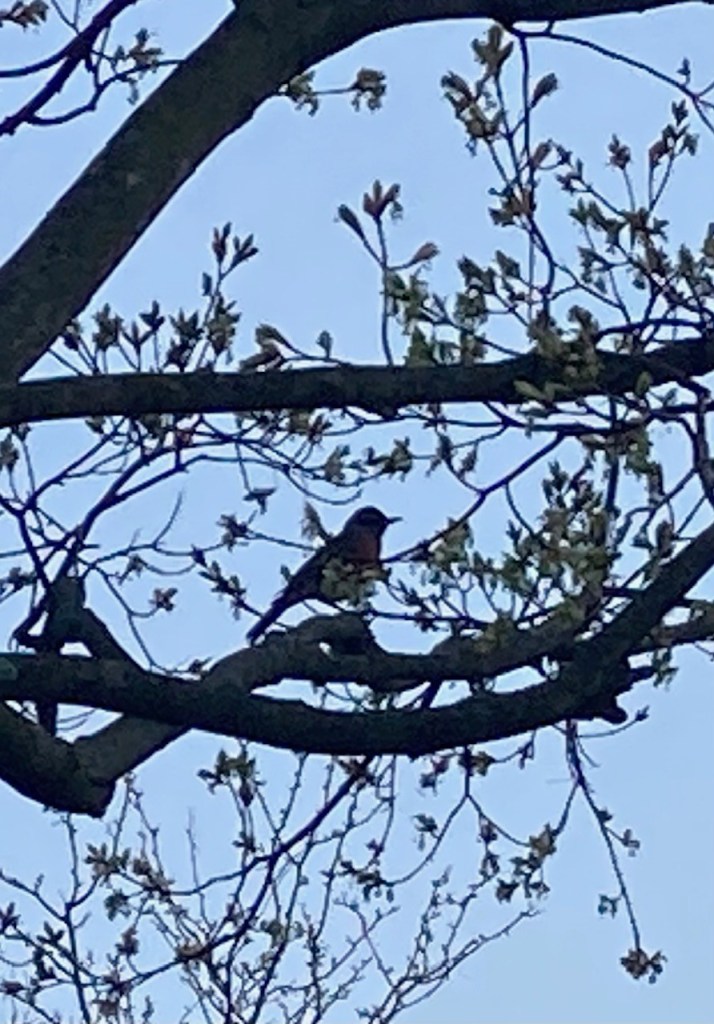
Last year, I took this photo during an early Sunday hike; I heard the bird’s song and then found it in the midst of a flowering tree.  

A photograph of a small bird sitting on a tree branch in the midst of blossoms. 

A photograph of a small bird sitting on a tree branch in the midst of blossoms.  

“The view, reminiscent /
Of project long-distant, /
Past print in a type of cyano.”

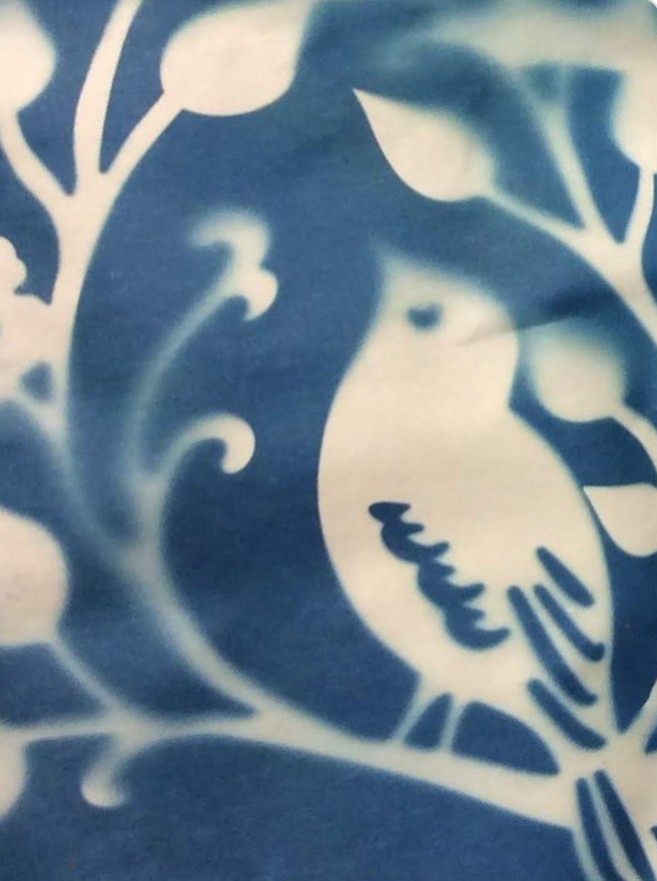
The scene last April had reminded me of one of my earliest (“long-distant”) cyanotype attempts, used to illustrate a much-earlier April poem, translated in a much-earlier April post

I had used a simple stencil with commercially available photosensitive paper, which is a far cry from what actual cyanotype artists do. However, it was still a striking image. I particularly enjoyed how the visual effects reversed between the cyanotype (where the bird was lighter than the background) and the April 2025 photo (where the bird was silhouetted against the sky).        

A cyanotype print in which the characteristic deep blue background contrasts with an image of a small bird sitting on a tree.

A cyanotype print in which the characteristic deep-blue background contrasts with an image of a small bird sitting in a tree. 

With the last line, I had originally written “Past print in a tint of cyano,” to achieve the internal rhyme. I ultimately decided that, for something standing on its own on Bluesky, it made sense to more directly cite the technique.  

Cyanotypes were pioneered by Sir John Herschel (whose scientific accomplishments are many!) and popularized by Anna Atkins, among others, during the 1800s.     

Categories
Science Poetry

To the Letter

“Element-naming:
Consider potassium,
Alkaline nature seen
Back in the day.  
Saga through history:
Named after potash;
The Latin form, ‘kalium’;
Symbol is K.”  

The 19 April 2025 Bluesky poem featured the last of the week’s etymologic tributes.  It celebrated a theme I’ve examined before, that of an unusual element abbreviation; in this case, the element of interest was potassium.  

“Element-naming: /
Consider potassium…”

As with sodium, highlighted here a while ago, this story told through this poem can become circular.  It will ultimately link potassium with its non-intuitive chemical symbol, the letter K. 

(Like the last few essays, the inspiration for this poem and post were derived ultimately from Isaac Asimov’s Words of Science and the History Behind Them.)       

“Alkaline nature seen /
Back in the day. /
Saga through history: /
Named after potash…”

Potassium is an alkali earth metal; it is placed in Group 1A on the Periodic Table of the Elements (PTE), and its compounds exhibit alkaline (basic) behavior.  The term alkali, in turn, is derived from “al qaly” in Arabic, reflecting the plants from which such substances were found (that is, the plants in question were found near the qaly (saltwort)). 

Asimov notes that ashes of these plants (the “pot ash”) could be used to form an ingredient in making an effective soap.  Potash is now recognized as a combination of ionic salts with potassium acting as the common cation.    

“The Latin form, ‘kalium’; /
Symbol is K.”  

Potassium was one of the elements identified conclusively by Humphry Davy via electrolysis in 1807.  Because it was isolated ultimately from pot ash, Davy at that time named it potassium.  German chemists, in experiments with and observations of the same element around the same time, deemed it kalium, based on the Latin word.

This difference persists today!  The English-language version of the PTE today reflects both influences, with symbol K and name potassium.  The German-language version of the PTE lists the name for potassium as kalium and denotes element 11 (sodium) as natrium (Na), clarifying the relationship between name and symbol.  

Categories
Science Poetry

Same, Difference

“Same atoms; distinct connectivities:
Two isomers’ key descriptivities.  
With ‘parts being equal,’
Second structure’s a sequel
To first, in atomic vicinities.”

The 18 April 2025 limerick continued the week’s focus on scientific vocabulary, this time via a chemistry-specific term: “isomer.”  

“Same atoms; distinct connectivities: /
Two isomers’ key descriptivities.”    

For students taking Organic Chemistry, a common early learning goal involves the classification of two given molecules as structural isomers or stereoisomers (or neither). 

Structural isomers are also called constitutional isomers; these are molecules with the same molecular formulas (same number of each type of atom) that differ in the order that the component atoms are connected. In stereoisomers, both the molecular formulas and the connection orders are the same, but the three-dimensional arrangements of the atoms differ.  

Each of the major classifications here involves several more subcategories (i.e., tautomers, enantiomers, etc.), each of which takes much time to visualize and learn.  Learning these nuances is generally enough work that we do not further delve into the etymologies of the terms, but those can be nonetheless fascinating.       

“With ‘parts being equal,’ /
Second structure’s a sequel /
To first, in atomic vicinities.”

In his 1959 book Words of Science and the History Behind Them, Isaac Asimov explains that, in 1830, chemist Jöns Jakob Berzelius noted the increasing number of situations in which new compounds were being discovered that had the same molecular formulas but different properties.  Berzelius suggested the name isomers to distinguish these cases from one another: iso from the Greek for “equal,” and mer from the Greek for “parts.”  

The poem celebrates the fact that while the numbers of component atoms in two isomers would be the same, the “atomic vicinities” within those isomers would differ.   

As with much chemistry vocabulary, “isomer” was a word I had used for many years without truly considering its origin, until last April’s poetic routine. 

Categories
Science Poetry

Temperature Gauge

“A read of the term here is literal: 
‘One hundred steps’ seen in the interval 
From boil to freeze  
As we scale the degrees 
In the temp’rature’s centigrade water-fall.”

The 17 April 2025 limerick again built on information I learned from Isaac Asimov’s 1959 book, Words of Science and the Histories Behind Them.  This particular poem commemorated the Latin roots of the word “centigrade.”       

“A read of the term here is literal…” 

Many temperature scales exist and are useful in different contexts.  Several are named for the scientists who devised them, such as Daniel Gabriel Fahrenheit; William Thomson, 1st Baron Kelvin; and Anders Celsius.     

“One hundred steps’ seen in the interval /
From boil to freeze / 
As we scale the degrees /
In the temp’rature’s centigrade water-fall.”

The Celsius scale was known first as the centigrade scale.  A temperature scale is defined via two reference points.  Anders Celsius proposed in 1742 that a new scale be defined, with water as the reference material: zero could be used for the boiling point and 100 for its melting point.  He further proposed one hundred steps between them, using the term “centigrade” to denote this (“centum” means “one hundred” in Latin; “gradum” means “steps”).  

The two references were ultimately reversed, and the scale was renamed in 1948 in Celsius’s honor.  Thus, in our current experience, 0 °C now represents the temperature at which ice melts to form liquid water, and 100 °C represents the temperature at which liquid water boils to form steam.  

The Celsius scale is closely related to the Kelvin scale: for instance, a difference of ten degrees Celsius would be equal to a difference of ten Kelvin.  The Kelvin is the SI (International System of Units) unit of temperature, and its scale extends to absolute zero: 0 K, or -273.15 °C.  Temperatures expressed in degrees Celsius can be easily converted to Kelvin by adding 273.15. (Because the Kelvin scale is absolute, SI convention states it does not use the “degree” sign or notation.)  

Categories
Science Poetry

Sky Lights

“Read past-astronomical ponderings,
Ideas of odysseys, conjuring. 
Stars: fixed in the sky,
But some objects move by–
The planets, so deemed for their ‘wandering.’” 

The 16 April 2025 Bluesky limerick was another that built on the etymology of a common scientific term, from Isaac Asimov’s Words of Science and the Histories Behind Them.  In this case, the term in question was “planet.”  

“Read past-astronomical ponderings, /
Ideas of odysseys, conjuring.”  

Throughout ancient history, seven lights could be seen to travel more seemingly-randomly across the sky, rather than making the consistent patterns that the stars did.  (Asimov notes that the latter are sometimes called the “fixed stars” for this reason, since constellation shapes do not change.) These seven entities that underwent comparative “odysseys” are now known as the Sun and the Moon, and as Mercury, Venus, Mars, Jupiter, and Saturn. 

“Stars: fixed in the sky, /
But some objects move by– /
The planets, so deemed for their ‘wandering.’”       

Writing about these etymologies in more detail sometimes seems strangely circular (should I describe those five planets as such, in the expanded prose, before the word is officially introduced in the poem?). In this case, the last line finally links the term of interest to its original Greek derivation, since planetes means “wanderer.”  Looking up the current definition reveals considerable additional precision now used with the term “planet,” from centuries of astronomical use.  

It is also interesting to consider the long shadows that these seven historical observations cast on our calendar.  The seven-day week was established during the time of the Roman Empire, building on much more ancient traditions.  It’s possible to link the name of each of the seven historically-observed heavenly bodies to a current day of the week, via several mythological equivalencies and subsequent translations.  The sun and moon are evident in Sunday and Monday, respectively; Tuesday links ultimately to Mars; Wednesday, to Mercury; Thursday, to Jupiter; Friday, to Venus; and Saturday, to Saturn.   

Categories
Science Poetry

Building Blocks

“A building-block term first-admissible; / 
To everyday vision, invisible, /
The atom in logic /
Most etymologic /
Takes name from the Greek: ‘indivisible.’” 

The 15 April 2025 Bluesky poem explored the etymology for the word “atom.”  As noted last week, this essay and the next few will build primarily on the information from Isaac Asimov’s Words of Science and the History Behind Them, written in 1959.     

“A building-block term first-admissible; / 
To everyday vision, invisible…”

In chemistry, we see atoms as the “building blocks” that lead in their combination to chemical compounds.

The vocabulary term atom has an intriguingly complex history, originating millennia ago in classical history with the Greek philosophers Leucippus and Democritus.  They postulated the existence of tiny particles making up all materials, far beyond limits of “everyday vision,” and deemed these atomos, for “indivisible” or “uncuttable.”  

In some ways, their discussions seem unusual today.  Leucippus and Democritus thought that the properties of different materials would depend on the shape of the atoms: for instance, that hot and cold substances derived their hotness and coldness from their component atoms’ shapes.  However, the idea of everyday materials consisting of unseen, tiny pieces (also discussed in ancient philosophies elsewhere in the world) was itself a major insight.     

“The atom in logic /
Most etymologic /
Takes name from the Greek: ‘indivisible.’” 

When John Dalton proposed his atomic theory centuries later, he used this Greek term.  He stated that each element was composed of a unique type of atom: i.e., an atom of carbon would be fundamentally distinct from an atom of gold.  His use of the Greek term was logical in terms of his understanding of the atom at the time (“logic/ most etymologic”), as the smallest possible piece of matter. 

The current understanding of matter involves tinier pieces still: chemists consider the atom as consisting of protons, neutrons, and electrons, while physicists would discuss even smaller constituent parts.  

This link, from the blog Compound Interest, provides a superb visual overview of what scientists have meant by the word “atom,” from Dalton’s 1803 theory onward.    

Categories
Science Poetry

Close Reads

“Intro classes’
Sweeping natures:
Learn AND speak
The nomenclatures!  
Some, acknowledged;
Many, hid;
Closer reads can 
Build a bridge.”  

As I begin a new semester this week, it’s a good time to bring back the NaPoWriMo2025 translation routine. 

This poem was posted on 14 April 2025 on Bluesky and kicked off a week in which I explored the etymology behind several scientific terms, as detailed in Isaac Asimov’s fascinating book Words of Science and the History Behind Them, published first in 1959.  

Asimov’s book delves into the history behind several terms from physical science, providing space and context for a perspective broader than what is typically used in an introductory course.  I remember wishing for something like his book as a student (and yet am not terribly surprised that it took me this long to find it as a faculty member).     

“Intro classes’/
Sweeping natures: /
Learn AND speak /
The nomenclatures!”

In an introductory science course, students are learning the vocabulary (the “nomenclatures”) and simultaneously applying the vocabulary via complex problems, case studies, and lab experiments.      

“Some, acknowledged; /
Many, hid…”

Chemical nomenclature (or “IUPAC nomenclature,” where IUPAC stands for International Union of Pure and Applied Chemistry) is a massive endeavor in itself: a standardized, self-consistent naming scheme whereby any chemist can write a name for a compound that another chemist can interpret.  

Although it is the most obvious and “acknowledged,” the IUPAC naming scheme is just one of many nomenclatures introduced in an introductory chem course. 

The idea of familiar words’ taking on increasingly precise meanings in a scientific context (e.g., “base, “aromatic,” “resonance”); the need to be fluent with interpreting and writing scientific notation; the unusual vocabulary underlying scientific history, with so many “strange terms to fit the strangeness of the thing”– each of these goals constitutes to an extent its own language-learning challenges.  

Thus, many vocabulary goals in an introductory course, while similarly crucial, are comparatively “hid[den],” compared to the formal, disciplinary nomenclature.         

“Closer reads can / 
Build a bridge.”  

Asimov notes, in his book’s introduction: “Entering the world of mathematics and science turns into a meeting with a whole realm of new words… The scientific vocabulary is the bridge by which we enter the land, not the wall that keeps us out.”  

This theme appeals greatly to me, as someone interested in both chemistry and language, and it was fun last April to devote a week of poems to structuring verses around some of the definitions Asimov recounted.  I similarly look forward to revisiting them here.