“Note light’s seeming-tangible scattering; /
A sunset, ostensibly ‘matter-ing’; /
Crepuscular rays /
In these long-evening days, /
With twilight depictions most flattering.”
Returning to the NaPoWriMo routine, the 12 April 2026 limerick commemorated an evening sight that I hadn’t realized the words for until I deliberately sought them out. The poem accompanied a posted photograph, included here, showing the phenomenon in question.
“Note light’s seeming-tangible scattering; /
A sunset, ostensibly ‘matter-ing’…”
Sunsets can be particularly striking when the clouds scatter the light into near-tangible-seeming streaks of light, as shown below.
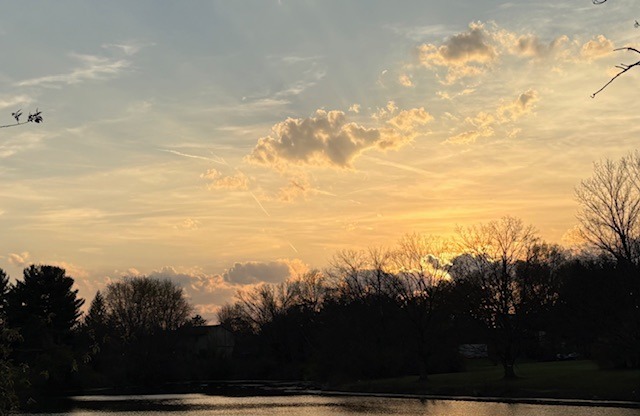
My siblings and I grew up in various parsonages, and we still use the shorthand of “bulletin-cover clouds” for seeing such images, since we recall their being used as cover illustrations on church publications throughout our childhoods. (It’s a practice that has fallen out of fashion since then, but just internet-searching for “church bulletin clouds” seems to bring up a lot of what I remember.)
“Crepuscular rays /
In these long-evening days, /
With twilight depictions most flattering.”
When I saw the same type of sky-set occurrence last spring, I decided to track down the more formal name, and I found it to be “crepuscular rays.” This term originates in the (similarly metrically excellent) Latin word crepusculum, which translates to “twilight.” The descriptor is also used with animals that are active primarily at twilight. This was thus a more direct path from observation to characterization than I sometimes find: the crepuscular rays are the distinctive light effects that are sometimes visible at twilight.
Scientific jargon has both benefits and costs, but one of the welcome domino effects of my own experience is that, from being more aware of the accurate phrasing for specific situations, I notice seeing them more often. These “most flattering” sunset sights are always welcome.


You must be logged in to post a comment.