“Post week-and-a-half trip’s duration /
Of lunar and space exploration… /
To Artemis 2: /
Welcome back, valiant crew, /
With over-the-moon exultation!”
The 11 April 2026 limerick heralded the close of the Artemis II mission, which had seen the astronauts return safely the evening before.
“Post week-and-a-half trip’s duration /
Of lunar and space exploration…”
As when I had witnessed the solar eclipse two years prior, I found myself wishing I knew much more about astronomy during early April. Nonetheless, it was helpful in that busy time of the semester to have such an interesting, science-focused event in the news, and to learn more about the range of experiments and projects underway during the ten days of the mission.
“To Artemis 2: /
Welcome back, valiant crew, /
With over-the-moon exultation!”
Additionally and more generally, this was the first moon mission I had ever observed; it was inspiring to see the immense competence and courage of the four astronauts, as well as of the many scientists in their support system at Mission Control.
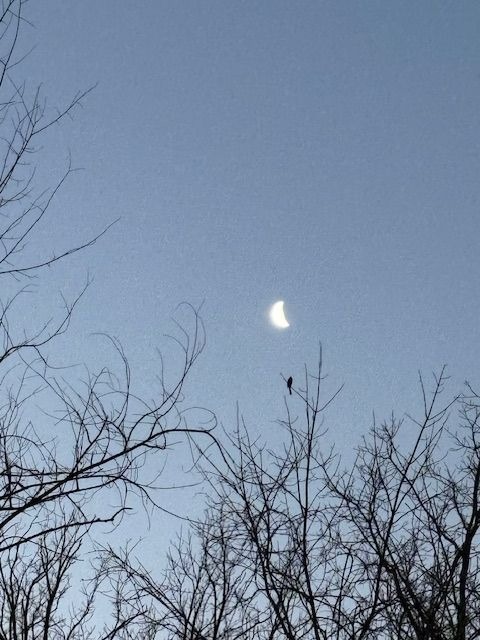
On the Friday night that the crew returned, I was one of many who watched the return flight and splashdown and celebrated their safe arrival home on Earth. The next morning, on an early walk, I was pleased to see the moon vividly in the sky, and I took a quick photo.
***
The “moon snapshot” pun in the title merits a postscript. The word snapshot had been proposed by Sir John Herschel, who anticipated during the range of photographic advances in the mid-1800s that there might someday be an image that could be generated in less than a second (far less time than the early techniques were requiring). Knowing Herschel’s polymathic scholarship, I was intrigued to see whether he had ever studied the moon directly. While it seems that this was not the case (rather, someone had instead impersonated his name and legacy in creating a famous moon hoax during the 1830s!), I learned that aspects of his work did overlap, given his support of the Julian system used in astronomy for precise calendar information.


You must be logged in to post a comment.