“’A first step t’ward /
Molecular depictions,’ /
Chem profs say. /
‘Electron regions /
Will repel!’ /
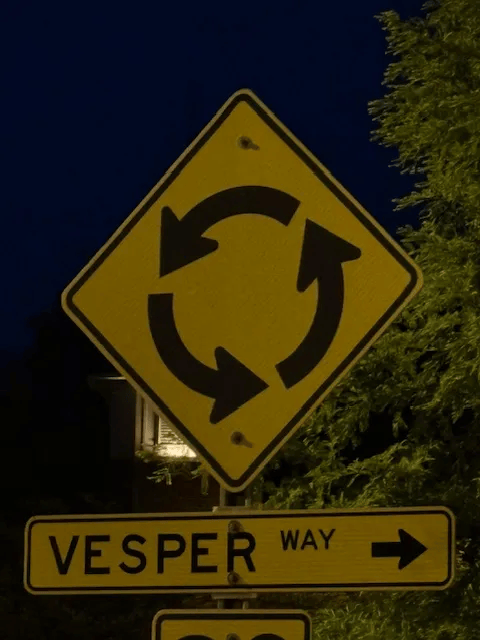
This is the VSEPR Way.”
The 4 April 2026 Bluesky poem was one of several in 2026 that used photos from my daily walks to provide the punchline of the poem: here, a traffic sign pointing toward a street named Vesper Way.
As the academic path of General Chemistry winds back through electron configurations (recently) and toward molecular geometries (in a few weeks), it seems an appropriate time for this essay.
“‘A first step t’ward /
Molecular depictions,’ /
Chem profs say…”
This is my current framing of valence-shell electron-pair repulsion (VSEPR) theory, when I teach. This theory arrives after a presentation of electron-dot structures (Lewis structures), which provide a two-dimensional representation of the connectivity in molecular compounds. VSEPR theory is thus a “first step” towards understanding three-dimensional molecular geometries (“depictions”).
“‘Electron regions /
Will repel!’ /
This is the VSEPR Way.”
When I encountered this theory, as a student, it was as a strange-to-me acronym that seemingly everyone else already knew to pronounce as a word (“vesper”) that itself has a distinct meaning that was not acknowledged at all. Learning VSEPR theory involved memorizing countless more non-intuitive terms involving words that I already knew (seesaw, octahedral) but in contexts that I didn’t.
That frustrating phenomenon continued through much of my early years of chemistry coursework and is something I attempt to directly anticipate now, in teaching. (“You might say, correctly, that the molecule’s shape doesn’t look at all like a seesaw from this perspective! But it does, a bit more, from this one.”)
Even now, as I look at a comprehensive discussion of the theory, I note some points that I’ve taught for years and some that I’ve rarely encountered. (For instance, VSEPR is also known as the Gillespie-Nyholm theory or the Sidgwick-Powell theory, in honor of some of the names associated with its development, building on work by chemist Ryutaro Tsuchida. However, these names were new to me in drafting this essay.)
As I pass the “Vesper Way” traffic sign on walks, it is impossible at those times not to think of the “VSEPR Way” I teach.


You must be logged in to post a comment.