The images: nightfall, abstracting, /
With chemistry vivid-impacting. /
A mid-July verse /
Heralds ROY-G-BIV bursts, /
As fireworks’ light is diffracting.
This next summer poem centers around some photographs I took at my town’s Fourth of July celebration a few days ago, using a diffraction grating over the camera lens. Given my low-key and time-sensitive “experimental question” that evening (essentially: will this work?), I was pleased to see how these turned out.
“The images: nightfall, abstracting, /
With chemistry vivid-impacting.”
I was inspired to try this after seeing some June updates from the superb Science History Institute in Philadelphia; they had posted some social-media images of their exhibition of historical fireworks as viewed through diffraction gratings, yielding characteristic rainbows.
I was intrigued as to whether I could see any similar effects with the more familiar aerial fireworks, given that those are farther away and fleeting in timescale, at the then-upcoming Independence Day celebrations in my own town.
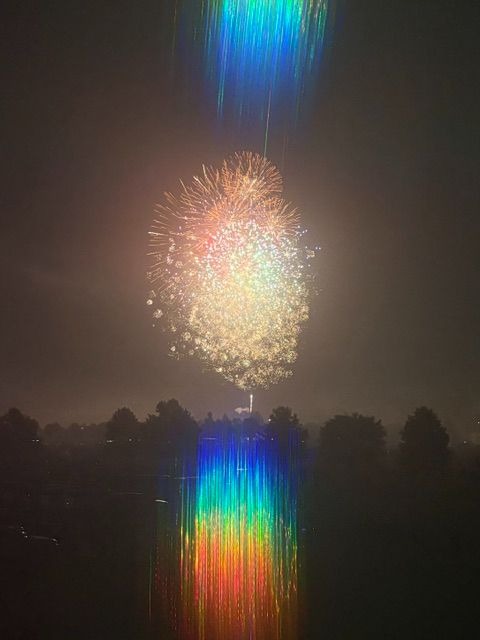
It was fun to quickly discover that it indeed did work!

The tell-tale diffraction effects were immediately visible, and the resulting photos preserved them.
“A mid-July verse /
Heralds ROY-G-BIV bursts, /
As fireworks’ light is diffracting.”
Diffraction occurs when light passes through a small opening and its waves spread out. A diffraction grating is made up of regular, tiny openings that yield a consistent pattern. White light consists of the entire ROYGBIV rainbow of visible light, and so when it passes through these openings, the different component colors are spread out to different extents. This phenomenon is most pronounced with the longest-wavelength light; for instance, we can see how red is “farthest” from the central firework in the photos above, since red light has the longest wavelength of visible light.
My July 4 investigation took about as simple an approach as it possibly could; it was a linear diffraction grating (so splitting light into ROYGBIV colors along one axis only), and I taped it over my phone camera.
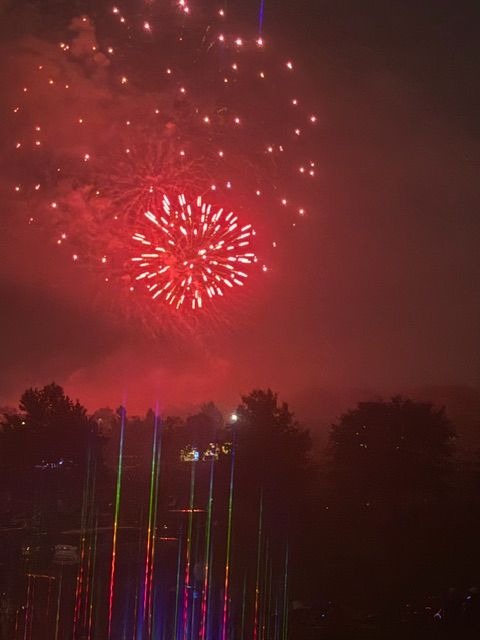
I could imagine many next steps, if I had not been in a crowd where viewing space and time were both at a premium. I later wished I had tried at least rotating the filter to see the horizontal diffraction, and I had originally contemplated taking a few more complex gratings along, to yield images in both directions at once (but the cost-benefit analysis in terms of annoyance to my neighbors did not seem worth it, especially in a first attempt!). I was also intrigued as to how/whether different colors of fireworks yielded obviously different observations, although I would guess that virtually any of them generated enough white light to see some ROYGBIV splitting, as with the red firework below.
On a related note, the chemistry of fireworks themselves (their molecular-level chemistry, not just the behavior of the resulting light) has been explored and documented in many excellent sources. For instance, the website Compound Interest has a beautiful infographic that describes the multiple chemical components and their roles. The Smithsonian’s science education blog likewise presents a fascinating historical and scientific overview.
***
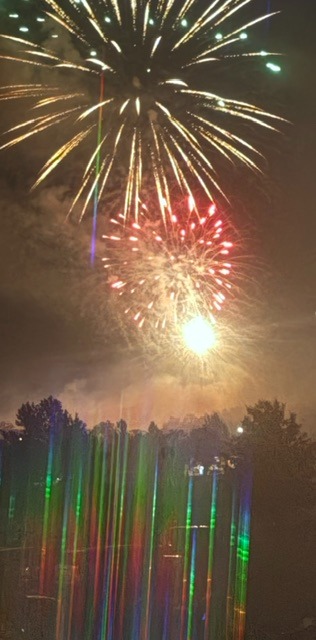
I will close this week’s essay with my favorite photo from that evening. The diffraction and the non-symmetric setup of the shot combined to give rise to a more artistic effect.


You must be logged in to post a comment.