Categories
Science Poetry

Right to Read

“Some unit conversions are gen’rable
From temperature-title most ven’rable,
But data retention
In SI dimensions—
Kelvin 506— seems far less mem’rable.”

The next poem was posted on 24 April 2023 in honor of Right to Read Day, specifically. It kicked off a week wherein I aimed to highlight chemistry-adjacent themes from famous authors, in terms of their books or quotes about writing or reading.  This first limerick noted Ray Bradbury’s Fahrenheit 451 in the context of a temperature conversion.  

“Some unit conversions are gen’rable /
From temperature-title most ven’rable…”

Dimensional analysis is a common skill developed in General Chemistry coursework.  It is often useful to quickly convert from one unit to another: for instance, to be able to express a volume in cubic meters or in liters, or to express a velocity in miles per hour or meters per second. These steps are called unit conversions.

Bradbury’s book is celebrated as a classic and was a focal point of 2023’s Right to Read Week.  The “temperature-title” is venerable.  

“But data retention
In SI dimensions—
Kelvin 506— seems far less mem’rable.”

The title of Fahrenheit 451 was based on the ignition temperature of paper, given the initial role of Bradbury’s protagonist as a “fireman”: in the novel’s dystopian future setting, one who burns books.  (The character refrains from that role over the course of the plot and resolves instead to help preserve literature.)

It is possible to generate temperature expressions using a wide range of units: “the unit conversions are gen’rable.”  Via these unit conversions, the temperature of 451 degrees Fahrenheit is equivalent to 506 Kelvin or to 233 degrees Celsius. 

However, as the poem notes, Bradbury’s famous title “seems far less memorable” when expressed on other scales, specifically the SI (International System) unit for temperature, which is the Kelvin, abbreviated as K. 

Categories
Science Poetry

Natural Philosophy

“Of heaven and earth, often dreaming
In one’s philosophic name-scheming;
Still more things observing–
Consid’ring unswerving–
With world full of wonders still-teeming.”

The 23 April 2023 Twitter limerick was posted in honor of William Shakespeare’s birthday.  This April date has been one of my favorites to commemorate over what have now been five NaPoWriMo (National Poetry Writing Month) routines.  

“Of heaven and earth, often dreaming /
In one’s philosophic name-scheming…”

This year’s poem alludes to a famous exchange from Hamlet.

“HORATIO.
O day and night, but this is wondrous strange.

HAMLET.
And therefore as a stranger give it welcome. /
There are more things in heaven and earth, Horatio, /
Than are dreamt of in your philosophy.”

Shakespeare’s Hamlet; Act One, Scene Five

In context, the lines refer to Hamlet’s recent sighting of his father’s ghost, but the quote has been much more generalized in several other settings (including this one!).  

“Still more things observing– /
Consid’ring unswerving– /
With world full of wonders still-teeming.”

In this poem’s case, the idea of “more things in heaven and earth… than are dreamt of” seems a resonant phrase across disciplines, emphasizing imagination, observation, and creativity.  I also liked the link possible between the roles of natural philosophy (historically) and science.  Revisiting a phrase from line two, “philosophic name-scheming” was a phrase that both noted Horatio and Hamlet’s discussion and hearkened back to last year’s poem.  The latter had emphasized some links between roles of the poet and the scientist, in observing and naming phenomena, as commemorated in A Midsummer Night’s Dream.  

***

This will be a relatively prosaic piece compared to last year’s (“more matter, with less art” often seems an unintentional theme of this 2024 sequence of essays, in a busy semester).  However, it is again helpful to contemplate that spring, with all the highlights therein, is in sight. 

Categories
Science Poetry

The Greening Spring

“An annual consideration
With Earth Day’s April inspiration: 
The theme of year’s telling
Is algae, excelling:
Green chemistry’s spring celebration!”

The next Twitter limerick was posted on Earth Day (22 April) 2023 and finally shifted away from the relatively dry subject of reaction arrow notation!    

“An annual consideration /
With Earth Day’s April inspiration…”

Earth Day began as a celebration in 1970; it is held annually on April 22.  In parallel with this global celebration, the American Chemical Society highlights “Earth Week,” devoting the week including April 22 to a theme related in some way to environmental science.  

“The theme of year’s telling /
Is algae, excelling…” 

Themes for this chemistry-adjacent celebration of Earth Week vary from year to year.  In 2020, for the fiftieth anniversary of Earth Day, the theme was sustainability; in 2021, reducing the carbon footprint; in 2022, insect chemistry.  

In 2023, as highlighted in this poem, the focus was “the curious chemistry of amazing algae,” noting the role algae can play in biofuel development and other environmental-chemistry-adjacent topics.  Given the rhythm inherent in the limerick, “algae, excelling” became a better metric fit.  

“Green chemistry’s spring celebration!”

The last line summarized algae’s potential role for sustainability… and acknowledged its particularly fitting green color for such an annual celebration.  

The title of this post came, somewhat randomly, from a piece that E. B. White wrote within his book Trumpet of the Swan.  The song, “Ever in the Greening Spring,” came to mind when I saw “green” and “spring” adjacent in this final line. Here in the midst of February, that season still seems a bit distant; it’s helpful to remember it is on the horizon.

Categories
Science Poetry

End of An Arrow

“Curved arrows, the last in this series,
Address mechanistic-themed theories.
Show electrons’ movements
Through stepwise confluence;
Investigate synthetic queries.”

The 21 April 2023 Twitter limerick was the last to focus on a specific type of arrow used in chemical notation.  It highlighted the curved arrows that are prevalent in organic chemistry mechanisms.  

“Curved arrows, the last in this series, /
Address mechanistic-themed theories.”

Curved arrows are a convention used in organic chemistry to illustrate organic mechanisms: the depictions by which chemists map the theoretical step-by-step progress of multi-step chemical reactions.  I had mentioned these in an earlier poem and post from this month’s endeavor, and that poem then inspired a more deliberate focus on such notation, over the course of an entire week.  

“Show electrons’ movements /
Through stepwise confluence…” 

Electron flow is the phenomenon that drives organic chemistry, as nucleophiles (electron-rich species) donate their electrons to electrophiles (electron-poor species).  An organic mechanism is written as a series of steps in which electrons’ movements (more precisely, the movement of electron pairs) are illustrated, one step at a time.       

“Investigate synthetic queries.”

Why are arrow-pushing mechanisms useful?  They can allow organic chemists to ponder the feasibility of a particular “synthetic query,” better understanding why certain products form from certain reactants.   

***

A curved arrow is interpreted as showing the movement of the electron pair, which starts at the tail of the arrow and ends at the head of the arrow, in a given reaction step, as can be seen in some of the links from last year’s focus on mechanisms.  Each “end of an arrow” has a specific meaning for an organic chemist, in terms of the curved-arrow notation.

Moreover, I simply could not avoid the pun (on “end of an era”) as a title here; as with the series of essays on enthalpy way back in 2020 or on kinetics in 2022, this was an undeniably dense set of posts.  I’ll return to some less jargon-dependent rhymes in the weeks ahead!      

Categories
Science Poetry

On Average

“A resonance arrow, specific
In theory portrayed, scientific:
See multiple structures
Advance, through their juncture, 
Amount of chem info prolific.”

The 20 April 2023 Twitter limerick celebrated yet another type of arrow.  This one is called the resonance arrow, and it communicates information about bonding in molecules.  

“A resonance arrow, specific /
In theory portrayed, scientific…” 

The resonance arrow is a single line with a double-headed arrow on either side:

This arrow communicates information for a single molecular species (rather than a reaction or process), by acknowledging the specific concepts of resonance theory.  

“See multiple structures /
Advance, through their juncture, /
Amount of chem info prolific.”

Ozone (O3) is an example of a molecule that exhibits resonance.  I have shown below two Lewis structures that can be drawn for the molecule ozone (O3), connected by a resonance arrow.  Structure 1 has a double bond (two lines) between oxygen A and oxygen B and a single bond (one line) between oxygen B and oxygen C.  Structure 2 has a single bond between oxygen A and oxygen B and a double bond between oxygen B and oxygen C.    

The true picture of ozone is that each of its two bonding regions (one between A and B; one between B and C) is essentially “one and a half“ bonds; in other words, we need to mentally average the two structures shown to truly understand what is going on.

Structures 1 and 2 are thus called resonance structures, and their “average” is called the resonance hybrid.  Experimental support here includes the identical lengths for ozone’s two bonding regions and the fact that those bonds (128 picometers, or pm) are shorter than a single bond (143 pm) and longer than a double bond (121 pm) between oxygen atoms. 

In other words, we have to acknowledge the “juncture” of “multiple structures,” to better understand a molecule that exhibits resonance.  (This can all seem quite complex in its initial presentation!  The verse, as always, gives an overview only.) 

Categories
Science Poetry

Thinking Back

“An arrow deemed retrosynthetic
Portrays a reflective aesthetic:
Reverse contemplation
To starting location
In pondering routes hypothetic.”

The next type of reaction arrow highlighted in verse, in the 19 April 2023 Twitter limerick, was the “retrosynthetic arrow,” which visually indicates a specific type of analysis most typically completed by organic chemists.  

“An arrow deemed retrosynthetic /
Portrays a reflective aesthetic…”

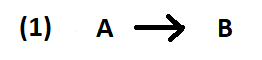
The retrosynthesis arrow has one of the most distinctive appearances of the arrows described in these poems, indicating the need for retrosynthesis: thinking backwards, via a “reflective aesthetic.”  It is a hollow arrow pointing from the left to the right.  It is probably most illustrative to contrast it with the other left-to-right arrow we’ve seen thus far. 

Reaction 1 (above) is the typical case we’ve seen before: Reactant A forms Product B. 

By contrast, Reaction 2 below indicates that we consider Species A as the target molecule in an organic synthetic project (the molecule that we want to synthesize in the lab). Species B in this case is the precursor: something that could be used as a reactant to form target Species A as a product. The unusual arrow communicates this thought process.  

“Reverse contemplation /
To starting location…”

Typically, then, we would continue thinking backwards, as in simplified Reaction 3: all the way to starting materials that were readily available (either easy-to-synthesize or listed in a catalog), generalized here as Species D.  

In poetic terms, our “reverse contemplation” would continue all the way back to “starting location.”

“In pondering routes hypothetic.”

Chemist E. J. Corey won the Nobel Prize in 1990 for formally developing the technique of retrosynthesis.  This “pondering [of] routes hypothetic” has led to many insights in organic chemistry. 

Here, the subtle difference in arrow notation indicates a specific and valuable technique for an organic chemist to understand. 

Categories
Science Poetry

Back and Forth

“A route’s back-and-forth versatility:
A question again for agility
Of arrow notation:
Tell-tale variation
Can indicate reversibility.”

The 18 April 2023 Twitter limerick continued a sequence of poems that aimed to highlight different types of arrows used in chemistry communication.  

“A route’s back-and-forth versatility: /
A question again for agility /
Of arrow notation…

We typically consider reactions as going only in the forward direction, from Point A to Point B, from reactants to products.  However, it is more precise to say most reactions are reversible, so that either direction (Point A to Point B…OR Point B to Point A!) can technically be favored by considering the reaction conditions of interest.  (Varying the temperature, pressure, and amounts of species involved in the reaction equilibrium would be a few ways to achieve this.)  

This aspect of a chemical reaction (“the route’s back-and-forth versatility”) can be specifically shown in a few ways.  The most characteristic denotation is two half-headed arrows, one pointing left and one pointing right, stacked on top of one another.  That is, rather than A → B, we would write A B.  We would describe this reaction as “shifting left” if the pertinent conditions tended to form more of species A or “shifting right” if the pertinent conditions tended to form more of species B.    

“Tell-tale variation /
Can indicate reversibility.”

This poem and the next few will highlight increasingly specific notation variations that indicate increasingly specific chemical principles: in this case, the “tell-tale” reaction arrow of interest highlights the reversibility of the reaction.  The double-headed arrow tells us something different than a “left-to-right” arrow would.    

As with last week, this post will be relatively brief, since the aim of each limerick in this series is simply to highlight (and describe) how the featured type of arrow is distinct from the others.  

Categories
Science Poetry

Step Forward

“The arrow’s most classic citation
Provides chem reaction’s narration:
Reactants yield products;
Denoting said progress,
The “verb” in the balanced equation.”

The 17 April 2023 limerick discussed the most traditional use of an arrow within a chemical reaction’s setting: showing the reaction progress moving forward from reactants to products.   

“The arrow’s most classic citation /
Provides chem reaction’s narration…”

If a student has encountered previous chemistry coursework, the first arrow of interest is likely familiar; it is a relatively “classic citation,” as such discussions go.  

When a reaction is written on a sheet of paper, reactants are written on the left-hand side, while products are written on the right-hand side. In between them is a single-headed arrow pointing from left to right.  

This arrow thus “narrates” the process by showing that the reactants on the left will form the products on the right, over the course of the chemical reaction.  

“Reactants yield products; /
Denoting said progress, /
The ‘verb’ in the balanced equation.”

These last three lines are a rhymed restatement of the last point from the previous section. This arrow in the reaction is what conveys the actual progress of the chemical step underway, becoming the “verb,” as one translates a chemical reaction’s notations to words.

Below is a reaction I’ve written about previously in this space, carbonatation (or carbonation), in which a fresco surface reacts with carbon dioxide in the air to provide a work of art notable for its longevity.  

Ca(OH)2 (aq) + CO2 (g) → CaCO3 (s) + H2O (l)

This reaction can be translated to words: aqueous calcium hydroxide and gaseous carbon dioxide react to form solid calcium carbonate and liquid water.  

The chemical formulas each correspond to a precise compound name; the letters in parentheses, to a description of each compound’s phase; the arrow corresponds to the phrase “react to form.”  

Future poems on this theme will examine arrows that represent more complicated phenomena, but this first example is relatively simple. 

Categories
Science Poetry

Arrow Analysis

“In reading reaction’s drawn evidence,
Consider notational relevance: 
What seems like a muddle
Of differences subtle
Resolves through an arrow analysis!”

I am back to campus for a new semester, and so it is helpful to also return to this writing routine. The second half of NaPoWriMo 2023 began with a set of Twitter poems highlighting “chemical notation week” in the hashtags, a theme that seems like a bit of a hard sell as I revisit these in early 2024!  I’ll plan on one post per poem, through the next several weeks; however, if the writing starts getting extremely dense, I might combine and summarize a few.

“In reading reaction’s drawn evidence, /
Consider notational relevance…”

The goal of this series of poems was to highlight how seemingly small differences in reaction arrow notation can play major roles in chemistry settings: how a “reaction’s drawn evidence” (its interpretation by another chemist) relies heavily on its specific “notational relevance” (the precise usage of the correct notation for the process of interest).  

This is a point that often can be frustratingly unexpected for chemistry learners: where what appears to be a small error results in what seems like a disproportionate effect on a graded assessment.  My goal was that this set of limericks would be an accessible and fun way to deliberately introduce and emphasize these important differences in notation.  

“What seems like a muddle /
Of differences subtle /
Resolves through an arrow analysis!”

The last three lines address what the themes of the next few poems and posts will be: first, that chemical reactions can communicate information that seems confusingly dense; second, that careful attention to these subtleties can resolve the confusion.  In particular, the many types of reaction arrows will be explored over the next several poems.

The last line relies on a pun between “error analysis,” which is a common theme of many lab reports, as the propagation of error throughout an experiment is quantified, and “arrow analysis”: the close examination of reaction arrows that these poems will involve. 

Categories
Science Poetry

Close Call

On precipice of winter-breaking,
With final-exam-prep painstaking,
These lines anapestic
Are far from majestic
(Last rhymed autumn-term undertaking).  

This non-Twitter poem probably requires little interpretation, near the close of a hectic semester, but I will give it a bit of additional context. 

On precipice of winter-breaking, /
With final-exam-prep painstaking…

We are in the last week of classes here, prior to Finals Week (and then the Grading/Meeting Weeks…), before a brief winter break. 

In the academic timeline, attention has thus shifted primarily to preparations for the final exams: reviewing and reflecting on the chemistry content from a busy semester.      

These lines anapestic /
Are far from majestic…

The metric feet used in limericks are anapests and amphibrachs. In this setting, the adjective form of the first lends itself particularly well to a sardonic rhyme, since my end-of-term work tends to focus primarily on simply accomplishing tasks, rather than achieving any sort of impressiveness in doing so!  The close of autumn term can seem particularly draining as the daylight wanes throughout the semester, whereas in spring, the shift back to longer daylight hours often provides a welcome boost in the last few weeks of the semester.         

(Last rhymed autumn-term undertaking).  

While it’s possible I might aim for a more extensive essay before year’s end, this will nonetheless be the last post during the autumn term itself, as highlighted in the last line. 

Together, the “precipice” of the first line and the semester’s drawing to a close are what prompted the title of this specific piece.