Categories
Science Poetry

Gold Standards

Methodical path algebraic /
Yields greatness from parts formulaic /
With images’ building /
From artisans’ gilding: /
In tesserae, steps toward mosaics.

This week’s summer poem again describes a more random theme. This one commemorates a combinatorial art form that I had been intrigued to learn more about, in developing some of my general education courses over the past academic year.  

“Methodical path algebraic / Yields greatness from parts formulaic…”

The fresco is generally my go-to source for chem-artistic themes, but I also have enjoyed learning more this year about the use of mosaics throughout history.  I had been aware of mosaics as compilations of tiled pieces for a while (thus thinking of them as a “methodical” process with “parts formulaic”), but I learned much more about the underlying materials in preparing my spring courses.  

“With images’ building / From artisans’ gilding…”

For one point, the tiled mosaic pieces themselves are known more precisely as tesserae, stemming ultimately from the Greek word for “four,” commemorating the geometric nature of the piece and anticipating terms like “tesseract.” 

For another, the use of gold foil in building some tesserae has been new to me, and it is quite fascinating.  Gold foil would be sandwiched between pieces of glass, then used to build up larger areas of gold on mosaics.  I have encountered discussions of how such tesserae were designed for religious environments, where candlelight’s reflection off a mosaic surface could be particularly striking.  While candles are no longer common lighting sources, the reflective effects endure.  

This makes sense: gold would famously NOT undergo the same redox chemistry that can change many artworks’ appearances over time.  (Gold is sometimes called a “noble metal,” given how little reactivity it exhibits, in a designation parallel to that of the noble gases.)     

“In tesserae, steps toward mosaics.”

I will record two connections here that I’ve noticed briefly in teaching and hope to write about more formally here, during the upcoming academic year.  

First, it is fascinating to compare and contrast a tessera, as an intentionally uniform and standardized piece of a mosaic, with the comparably constituent part of a fresco, denoted the giornata (for “a day’s work”) and thus highly individualized, since it was set out each day by the artist themselves. 

Second, gold’s malleability, specifically, is a property that (appropriately!) casts a wide and interesting shadow. Malleability is the ability of a metal to form a sheet; this ability allows gold foil’s use in mosaic art; it is famously cited as an aspect of the metal’s elemental properties; and it played a huge role in Rutherford’s key “gold foil” experiment, which provided experimental evidence ultimately supporting the nuclear model of the atom.

Categories
Science Poetry

Into the Blue

The focal length: conceit insightful /
In effort to find lensing rightful. /  
Close-up, panoramic, /
Or scope more dynamic, /
For stories hued deep to delightful.  

This week’s poem makes yet another summer jump, this time back to the concept of “focal length” as a metaphor for artistic viewpoint.  This builds from an insightful metaphor in Twyla Tharp’s The Creative Habit and is an image I’ve found helpful before.  

“The focal length: conceit insightful /
In effort to find lensing rightful…”

I was reminded of “focal length” this summer in hearing an outstanding podcast related to a (likewise outstanding) book by Victoria Finlay, as both overlapped with a topic I’ve taught in class.

The concept of the focal length, as introduced in Tharp’s book, pointed out that artists often engage with their work via one of three perspectives.  She writes, “All of us find comfort in seeing the world either from a great distance, at arm’s length, or in close-up… [W]e focus best at some specific spot along the spectrum.”  

I’ve discussed here before how, as I’ve been writing more creatively about chemistry topics, I’ve realized that my teaching relies fundamentally on the “arm’s length” view afforded by discipline-specific jargon.  It’s been humbling to realize how much I have to learn about the other two views, in communicating via more accessible writing about either molecular behaviors (“close-up”) or big-picture phenomena resulting from those behaviors (“great distance”). Finding the “lensing rightful” is an ongoing challenge.

“Close-up, panoramic, /
Or scope more dynamic…”

I have found some interesting support and connections this summer in considering this challenge.

I encountered the National Gallery’s superb podcast “Stories in Colour” last year and have greatly enjoyed it since.  This season, they presented an episode on ultramarine blue, as the natural pigment that is responsible for blue in older paintings. 

In terms of “focal length,” the jumps between various perspectives were fascinating, as the discussion moved from the mineral underlying the pigment (“close-up”) to the pigment’s use (“scope more dynamic”) and ultimately to several applications across art history (“panoramic”).  Victoria Finlay was a guest expert commentator, and I realized in listening that I’d read her excellent book on pigments years before.  I was particularly taken by how one of her most striking images was used in both her podcast interview and her book, but in different places.  

A brief bit of background: historically, ultramarine blue was a much rarer pigment than those used for other paint colors.  The mineral lapis lazuli was the expensive source for the color, due to its challenging geography and preparation (themes I will likely revisit more succinctly via an April 2026 poem when I’m in “Chem in Art mode” in the autumn).  Famously, Michelangelo left his 1501 painting The Entombment unfinished, and scholars speculate that it is because he had been waiting on a delivery of ultramarine blue pigment from a patron, with which to depict Mary and her traditionally blue robe in the lower right corner.  It did not arrive in time; Michelangelo moved on to other projects; the gap itself is now a major aspect of the painting.    

This story is what Finlay uses to introduce her chapter on blue in her book Color: A Natural History of the Palette.  Listening to the podcast on blue, I noted that in the Q&A format, the discussion of Michelangelo’s painting did not arise until much closer to the end.  Both presentations worked incredibly well, and I found myself thinking about why.  In this case, it wasn’t so much that the focal length changed that the medium did. 

A podcast, with its interactive approach, can draw in listeners in a different way than a book chapter, which must asynchronously stand alone.  The story of the painting raises such an interesting question (I remember literally “minding the gap” in reading Finlay’s book, in that I quickly was invested enough to continue on and seek out the answer!) that it is a perfect lede with which to begin a written chapter.  The podcast began with more technical, close-up information, bolstered by the inherently insightful, accessible Q&A format; it could build to a later discussion of the painting.

“For stories hued deep to delightful.”

As I have been working on more general writing here and via other projects, both focal length and medium are helpful constraints to keep in mind, in sharing stories from chemistry more broadly.  (Many of these stories have begun in the interdisciplinary overlap of chemistry and art, for me, as highlighted by the telltale use of “hue.”)

Categories
Science Poetry

Blue Skies

“A morning’s song from bird-soprano,
In tree-set melodic crescendo;
The view, reminiscent 
Of project long-distant,
Past print in a type of cyano.”

The 20 April 2025 limerick highlighted a memorable spring morning sight, linking it to a past “chemistry in art” project.  

“A morning’s song from bird-soprano, /
In tree-set melodic crescendo…”

Part of what I enjoy about the April poetry routine is that it also corresponds with a return to regular morning walks, after winter’s unpredictability.  Spring weather is always a help.  (I’m writing this particular post in the wake of a massive snowstorm and scheduling it for next month; I imagine the relief in 2026 will be particularly pronounced!)  

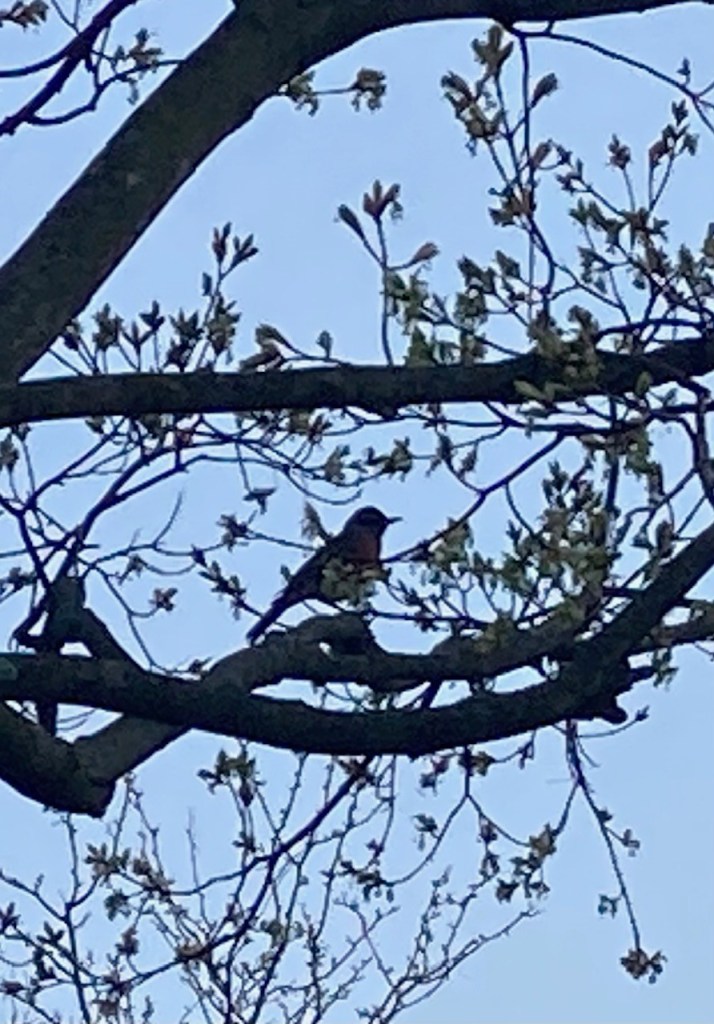
Last year, I took this photo during an early Sunday hike; I heard the bird’s song and then found it in the midst of a flowering tree.  

A photograph of a small bird sitting on a tree branch in the midst of blossoms. 

A photograph of a small bird sitting on a tree branch in the midst of blossoms.  

“The view, reminiscent /
Of project long-distant, /
Past print in a type of cyano.”

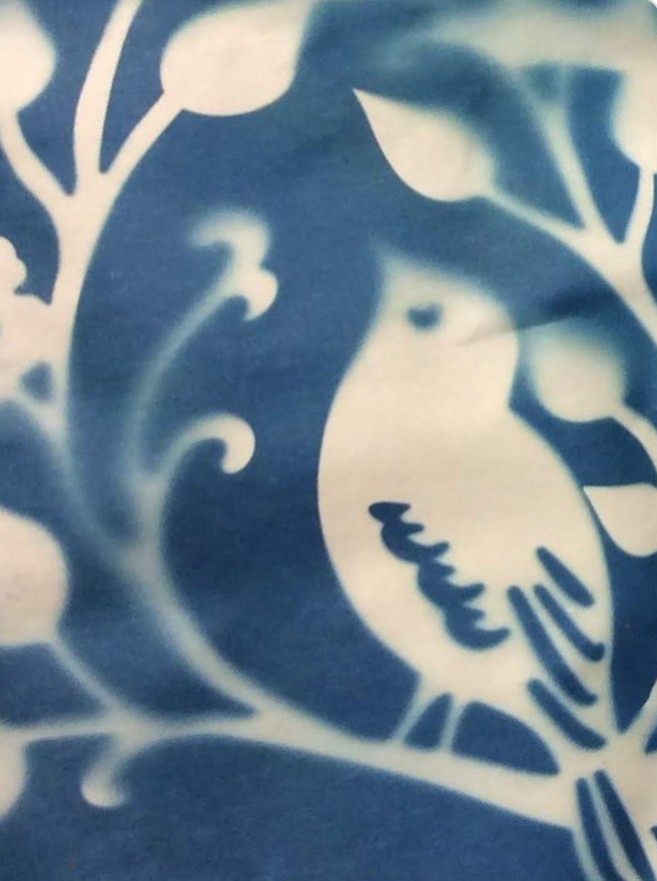
The scene last April had reminded me of one of my earliest (“long-distant”) cyanotype attempts, used to illustrate a much-earlier April poem, translated in a much-earlier April post

I had used a simple stencil with commercially available photosensitive paper, which is a far cry from what actual cyanotype artists do. However, it was still a striking image. I particularly enjoyed how the visual effects reversed between the cyanotype (where the bird was lighter than the background) and the April 2025 photo (where the bird was silhouetted against the sky).        

A cyanotype print in which the characteristic deep blue background contrasts with an image of a small bird sitting on a tree.

A cyanotype print in which the characteristic deep-blue background contrasts with an image of a small bird sitting in a tree. 

With the last line, I had originally written “Past print in a tint of cyano,” to achieve the internal rhyme. I ultimately decided that, for something standing on its own on Bluesky, it made sense to more directly cite the technique.  

Cyanotypes were pioneered by Sir John Herschel (whose scientific accomplishments are many!) and popularized by Anna Atkins, among others, during the 1800s.     

Categories
Science Poetry

Lighting the Way

A science-art phrase diagnostic 
Will center a compound base-caustic; 
Attention un-wavers 
On limelight’s behavior,  
As trips the light koniaphostic.  

It is once again the “fresco stretch” of my autumn semester, which always lends itself to interesting metaphors and vocabulary. In preparing notes this time around, I intentionally delved deeper into a fascinating tangent I learned about last year, with the similarly science-art-themed concept of the limelight: the light caused by the heating of calcium oxide, or quicklime, to temperatures at which the material becomes incandescent.  This is a non-NaPoWriMo limerick, but I’ll still aim to use my typical word count, to better distill my thinking.  

A science-art phrase diagnostic / 
Will center a compound base-caustic…  

The first two lines here acknowledge that the same compound (quicklime, or calcium oxide, or CaO) plays a crucial role both in fresco art and “in the limelight” of a theater production. 

With frescoes, calcium oxide is formed from calcination of calcium carbonate (CaCO3).  Calcium oxide then is mixed with water to form calcium hydroxide [Ca(OH)2], or lime plaster, which will constitute the actual fresco surface.  Calcium oxide is a basic compound (pH > 7), and one of the primary characteristics of bases is that they are caustic.  

Attention un-wavers /
On limelight’s behavior…

When heated to high temperatures, calcium oxide incandesces (glows) with an intensely white light.  This video provides an outstanding overview and demonstration.  

The resulting light is called the limelight because of its dependence on a calcium-containing compound.  Limelight was used historically in theaters to spotlight the star of the show; limelight behavior is more consistent and brighter than that of gas lighting (typically using hydrocarbon fuels, which create more soot and have other drawbacks).  

Limelight would presumably command “un-waver[ing]” attention compared to other sources.      

As trips the light koniaphostic.  

Discovering the word “koniaphostic” had prompted this poem for me this autumn, given its excellent metric fit within the limerick form!  The term was used in 1836 to describe limelight; its etymology seems to track towards the Greek for powder (konis) and light (phos).  

The fifth line is primarily an homage to John Milton’s “trip the light fantastic,” itself a poetic description of a performance.  Here, though, I intended the final line to animate the beam itself, as “the light koniaphostic” travels toward the stage.

Categories
Science Poetry

Wax Eloquent

In art form creative and elegant,
A use of chem properties prevalent…
If error avoided, 
Then product ovoid is
Example of wax resist, eloquent!  

This non-Twitter/Bluesky poem commemorates a fascinating art process I was introduced to last spring: the technique behind making pysanky.  (Since the concepts are still relatively new to me, I doubt my ability to be succinct and remain clear: I’ll plan to keep my word limit at 560 words this time.)      

“In art form creative and elegant…”

I was lucky to attend a pysanka workshop on campus in Spring 2024 to learn about this creative and elegant artwork from Ukrainian culture.  (Pysanka is the singular form of the word; pysanky is the plural.) To sum up any process in an introductory blog post does not do it credit, so I’ll add in some pertinent links here.  

In brief, a design is painted on the egg in beeswax, using a stylus that can deliver the wax in a thin line, and the egg is then dyed a color.  These two steps are repeated over several layers.  At the close of the process, all the wax is melted off, ultimately yielding an egg dyed in a variety of colors.  My own amateur attempts are shown here, but I recommend seeking out other images, as the resulting designs can be astoundingly intricate.     

“A use of chem properties prevalent…”  

I was quite interested in exploring the underlying chemistry that made this possible.  While I am still learning, it has seemed likely so far that the dyes used are examples of acid dyes: they are water-soluble and contain functional groups such as carboxylic acids or sulfonic acids that can donate a proton in water, so that the dye molecule takes on a negative charge.  Opposite charges attract, forming strong ionic bonds: thus, the negatively-charged dye then works well with protein-based compounds, which are also water-soluble and can form positively-charged species in the acidic dye bath.  

Eggshells consist of calcium carbonate and proteins, so they work well with acid dyes.    However, beeswax is resistant to such interactions, because it has a primarily hydrocarbon structure, being made of long-chain esters.  It is not water-soluble, and it does not have functional groups that can react with water to form anything charged, so it does not bond to an acid dye.  

Inherent in the art process are thus a variety of chemical properties of the materials used, such as solubility, miscibility, acid-base reactivity, and bonding.                 

“If error avoided, /
Then product ovoid is /
Example of wax resist, eloquent!”  

I was intrigued throughout the evening by how challenging and invigorating this “experiment” was. 

It was necessary to continually aim to create a negative image: the first area covered with wax would preserve the white of the eggshell. After the first dye layer was applied, the second area covered with wax would then preserve the color of the first dye. After the second dye layer was applied, the third area covered with wax would then preserve the color of the second dye, and so on.  

I found myself strongly reminded of the retrosynthesis problems I had worked decades before in Organic Chemistry, thinking backward one step at a time, all the way back to the starting material: here, the egg itself.  (My own endeavors were quite simple, but expert pysanka artists use a variety of symbols and designs with a wealth of meaning.)  

This was in addition to the many practical challenges involved in working with the set-up, since it relied on eggs, dyes, wax, and flames, all providing ample room for error!  However, even in my initial attempts, I was quite pleased to see the “product ovoid.”  

In researching the technique afterwards, I have likewise been interested to learn more about wax resist generally, seeing the principles that make such processes work from an artistic perspective.  (The “wax eloquent” phrase has been on my mind over the past year, given the intricacy and beauty of the sample pysanky that were shared at the 2024 workshop.)

Categories
Science Poetry

Set Time

“The last step seeks well-planned giornata;
Compels fresco artist to plot a 
Considered depiction 
In workday’s restriction,
Avoiding time-limit errata!”

The last of the three fresco-cycle limericks from NaPoWriMo2024 was posted on 17 April 2024 and focused on the final step: carbonation, or carbonatation.  Since I’ve used the name of this particular step as a punchline in a previous poem, I instead focused this limerick on a related concept: the time required for this last step to occur and the fresco image to thus become set.   

“The last step seeks well-planned giornata…

Giornata means “a day’s work” in Italian.  In fresco art, it means the amount of lime plaster that an artist covers with pigment during a day.  This is due to the specific chemistry of the carbonatation step, represented symbolically here:

Ca(OH)2 (l) + CO2 (g) → CaCO3 (s) + H2O (l)  

This reaction is key to the buon fresco (“true fresco”) art form.  If an artist paints on the intonaco layer of the fresco with pigments in water, the surface [consisting of calcium hydroxide, Ca(OH)2] then reacts with the carbon dioxide (CO2) in the surrounding air, forming a stable calcium carbonate structure around the pigments and ensuring the longevity of the work.  The artist would thus want to lay down only enough of the intonaco layer that could be covered with pigment in the same session.  

“Compels fresco artist to plot a /
Considered depiction /
In workday’s restriction…”  

I have written before about how the rules of poetic structures (such as limericks) have been a help in terms of re-starting my own creative writing processes.  I can imagine both that having to deliberately consider each giornata might help a fresco artist plan their work AND that such a restriction might be considerably more time-intense and frustrating than “five lines and an AABBA rhyme scheme.”  

“Avoiding time-limit errata!” 

Mistiming a giornata could be addressed, since fresco artists could also use the technique of fresco a secco (“dry fresco”).  As its name suggests, this technique involves painting on a dried fresco surface (directly on the already-formed calcium carbonate). 

However, the potential rhyme of “giornata” and “errata” proved impossible to resist, here.

Categories
Science Poetry

In the Limelight

“Step two in the fresco art-making
Is quicklime’s hydrational slaking.  
Lime plaster resulting
For next steps’ constructing:
Adhering-to-wall undertaking.”

The 16 April 2024 limerick continued the pathway of its predecessor, looking at the second step of the three-step fresco cycle, a process called slaking.   

“Step two in the fresco art-making /
Is quicklime’s hydrational slaking…” 

The reaction summarized here is symbolized as follows, as the quicklime (CaO) formed in Step 1 of the fresco cycle (calcination) is mixed with water, causing an exothermic reaction and the formation of calcium hydroxide: CaO (s) + H2O (l) → Ca(OH)2 (l)   

The reaction equation corresponds well to “quicklime’s hydrational slaking,” since quicklime is one reactant and water is the other.  

Two quick tangents here: first, “in the limelight,” as an idiom, refers to the intensely bright light caused by the behavior of quicklime, yet another fascinating point that I had never encountered until writing these pieces.  While unrelated to fresco, it seemed too good to pass up as a post title, since quicklime is still involved in this step.  

Second, “hydrational slaking” is admittedly redundant.  However, the latter term seems less familiar to students each time I teach.  I am sure I will persist in mentioning “slaking one’s thirst” in class as another way of saying “taking a drink of water,” since it seems a rare one-to-one correlation between everyday meaning and specialized vocabulary. 

“Lime plaster resulting /
For next steps’ constructing: /
Adhering-to-wall undertaking.”

The product in this reaction is “calcium hydroxide” to a chemist and “lime plaster” to a fresco artist.  It will be used in the next step, of constructing the fresco art itself.  A fresco consists of two plaster layers, the arriccio layer, adjacent to the wall, followed by the intonaco layer, the actual painting surface.  Both involve calcium hydroxide; the key difference between the two is the coarseness of the sand mixed into the plaster (finer sand is used for intonaco). 

Categories
Science Poetry

Fresh Start

“In kiln-heating limestone, occasion 
Of fresco’s first step: calcination.   
The process, applied: 
CO2 thus ‘excised,’ 
Yielding quicklime for next needed station.”   

The 15 April 2024 Twitter limerick was the first of three sequential verses summarizing the fresco cycle.   The sequence is a fitting theme with which to begin the Spring 2025 posts: fresco is Italian for “fresh” (hence the post title), and this art form is a fascinating one to view from a chemistry perspective, among many others.  

“In kiln-heating limestone, occasion /
Of fresco’s first step: calcination.” 

The fresco cycle consists of three steps: calcination, slaking, and carbonation (also called carbonatation).  While I’ve examined the overall process before, this sequence provided a chance to explore each step in greater detail.  

The first step, calcination, is represented symbolically via the equation:
CaCO3 (s) + heat → CaO (s) + CO2 (g)

Alternatively, the reaction could be shown with calcium carbonate (CaCO3) as the single reactant with a triangle, representing heat, written over the arrow (noting here what would be a fascinating tangent on its own: some sources trace this shorthand to the alchemical symbol for fire).  Calcium carbonate is also known as limestone; the more familiar name brings with it the bonus of simpler scansion.     

“The process, applied: /
CO2 thus ‘excised,’ /
Yielding quicklime for next needed station.”        

Heating calcium carbonate to high temperatures, as in Line 1’s kiln, drives the calcination step to the right, yielding calcium oxide (CaO) and carbon dioxide (CO2) as products.  

Calcium oxide is referred to as quicklime in the fresco process, and it will be used in the “next needed station” of the fresco cycle: the slaking step, which is what provides the slaked lime (calcium hydroxide) that will become the actual fresco surface.  

(As above, with the symbolic shorthand for heat, sitting with these terms during a break allowed me to explore an etymological question that often comes to mind in teaching this topic.  The “lime” of quicklime and lime plaster comes from the Old English lim, reflecting its stickiness as a building material, whereas the “lime” of the citrus variety comes from the Arabic limah and Persian limu.)  

Categories
Science Poetry

Blue Book

“Artist and scientist,
Anna C. Atkins,
With nature’s cyanotypes,
Technique refines.
Photos botanical
Yield tome expansible:
Blueprints for future work
Here intertwine.”  

The final “Twitter biography” poem from NaPoWriMo 2022 was posted on 15 April 2022 and noted some of the many accomplishments of botanist and photographer Anna Atkins (1799-1871).      

“Artist and scientist, /
Anna C. Atkins, /
With nature’s cyanotypes, /
Technique refines…”

Anna Christian Atkins was an English artist and scientist; she explored multiple interdisciplinary overlaps of scientific investigations and illustrations.  She learned the cyanotype technique from its inventor, a friend of her family: Sir John Herschel.  Cyanotyping is a photochemical process that takes advantage of the light-sensitivity of certain iron-containing compounds to generate images on a deep blue (cyan) background.    

Since Atkins was skilled at drawing and illustrating, she had particular insight into the value that a photographic technique could provide with scientific samples that defied hand-drawn record-keeping: in her words, such species were often “so minute that accurate drawings of them [were] very difficult to make.”  She used the cyanotype technique to precisely record aspects of several natural specimens.   

“Photos botanical /
Yield tome expansible: /
Blueprints for future work /
Here intertwine.”

Atkins used the cyanotype technique to develop a “tome expansible,” a book that is generally accepted to be the first compilation of photographic images: Photographs of British Algae: Cyanotype Impressions.  With some poetic license, this collection became “photos botanical” in the verse.  Pages from this book can be seen at the link and provide clear images of the intertwining, delicate samples of interest.  

Atkins’s book was an important historical document in its own right and also set the stage for the use of photography in scientific research for years to come.  The last few lines note this metaphorically and highlight the fact that the cyanotype process is the same chemistry behind the blueprint process.    

Categories
STEM Education Poetry

All Fresco

“A creative process, wall-stationed,
With paintings long-lasting, emblazoned;
The technique, pervasive
On surface abrasive,
Forms fresco through carbonatation.” 

The second mechanism poem from NaPoWriMo2022 was the most general of the verses from that week, posted on 5 April 2022.  It concerns the chemistry behind frescoes, an artistic medium seen widely throughout history and cultures, thus justifying to a reasonable extent (I hope) the pun in the post title.    

The topic of fresco chemistry involves much fascinating science, art, and history.  As with last week’s entry, the chemical reactions of interest here deserve some preliminary framing and additional words.  Unlike the SN2 mechanism and others that will be described in future posts, this is a process reflecting general inorganic chemistry steps, rather than the specific electron pushing of organic molecule depictions. However, it still seemed to fit reasonably well in this week.  Here, the abbreviations in parentheses denote the phases of the chemicals of interest: (s) for solid; (l) for liquid; (g) for gas; and (aq) for aqueous solution.   

Step One: CaCO3 (s) → CaO (s) + CO2 (g) 
Step Two: CaO (s) + H2O (l) → Ca(OH)2 (aq) 
Step Three: Ca(OH)2 (aq) + CO2 (g) → CaCO3 (s) + H2O (l)

The fresco cycle shown here is a three-step process.  The first two steps prepare an artist’s materials for this artistic medium.  The first is called calcination: calcium carbonate (CaCO3) is heated to yield calcium oxide (CaO) and carbon dioxide (CO2).  The second is called slaking: calcium oxide is mixed with water (H2O) to form calcium hydroxide [Ca(OH)2], known to fresco artists as lime plaster.  

The third step is the chemistry behind the fresco formation itself and the focus of the poem.     

“A creative process, wall-stationed, /
With paintings long-lasting, emblazoned…”

Frescoes consist of two layers of lime plaster used to coat a wall and create a painting surface (“wall-stationed”).  In the rougher layer, the arriccio, plaster is mixed with coarse sand and applied directly to the wall.  The intonaco layer (lime plaster and fine sand) is then applied over the arriccio layer to become the actual painting surface. 

In fresco chemistry, pigments are painted directly on a surface consisting of calcium hydroxide [Ca(OH)2].  As the fresco dries, the calcium hydroxide reacts with the carbon dioxide (CO2) in the air and forms the stable and long-lived compound calcium carbonate (CaCO3): trapping the pigments, leading to an image that will be “long-lasting [and] emblazoned” on the wall.  

A fresco artist ideally applies an intonaco layer only to an amount of wall feasible to finish before the plaster dries.  The corresponding term is giornata, for “a day’s work.”  

“The technique, pervasive /
On surface abrasive…”

The technique is “pervasive”: seen in many eras and locations throughout history.  Calcium hydroxide is a basic compound, bases are caustic; lime plaster is a “surface abrasive.” 

“…Forms fresco through carbonatation.” 

The last reaction in the sequence shown is called carbonatation, as it forms calcium carbonate.  It is sometimes called carbonation, but the first term is less ambiguous (multiple processes are denoted as carbonation)… and scans more readily in this limerick!

This reaction is key to the buon fresco (“true fresco”) technique, in which the artist is painting on fresh lime plaster, aiming to cover their giornata.  A related technique is called fresco a secco (“dry fresco”), in which the artist uses paints on an already-dried surface.