Through semester’s course and duration, Acknowledge the check of narration: The concepts we’ve pitched here Are always abridged— Nearer essence of lecture: curation.
This is a non-Twitter/Bluesky poem that I wrote a few years ago. I think of its themes increasingly often in the courses I teach, given that many of them are introductory. It seems worth taking some time this week to expand/explore these lines, as the end of the semester emerges in view (ever so slightly), on the horizon.
“Through semester’s course and duration, / Acknowledge the check of narration…”
The constraints of an introductory textbook mean that a textbook entitled Chemistry at best covers a significant portion of what chemists would agree on as the fundamental concepts, at the time of its writing, for an introduction to beginning students.
The constraints of a 55-minute class period mean that a small percentage of THOSE concepts are communicated synchronously there, once a professor has chosen a textbook to use for their course.
Given infinite time and undivided attention, I suspect that anyone would teach their subject in a different way; as that’s far from the case, we each have “check[s] on narration,” in preparing our courses.
“The concepts we’ve pitched here / Are always abridged…”
I emphasize to my students that the coverage of a chemistry curriculum is iterative. The concepts in an introductory course are significantly abridged compared to the substance of the discipline itself; it is expected for the material to seem overwhelming on a first pass.
“Nearer essence of lecture: curation.”
I remember a workshop early in my teaching career where a senior colleague from a different department, in an illuminating side comment, described their approach as “curation.” They noted that, with the ubiquity of the internet, their teaching had fundamentally changed: they saw one of their main class-time roles now as highlighting the most illustrative online resources via which a student could further explore a discipline on their own.
While the disciplinary content of chemistry is significantly different, I do think the ability of a class session to “curate” the most crucial concepts and techniques to understand, from an otherwise-immense amount of textbook material, is analogous.
“Exam week… and last panegyric Extolling new site of chem lyric: A step energizing In verse-enterprising; A blue shift, in terms atmospheric!”
This essay will mark the first time my original limerick will have been written for a different site, as I’ll share new poems on Bluesky, moving forward. I still am only about halfway through the Twitter poems from last April; thus, next semester will be an interesting blend of Twitter and Bluesky links, before the NaPoWriMo2024 set of poems is fully readdressed via the essays here. Regardless, this will be my last regular blog entry for Autumn 2024, after a long semester.
“Exam week… and last panegyric / Extolling new site of chem lyric…”
It’s Finals Week on campus, so it’s a logical time to bring the autumn sequence of essays to a close. My first few Bluesky posts have been rather sporadic, as I get used to the website (the “new site of chem lyric”), but it has been interesting and fun to rediscover other science poetry and creative work there. I hope to move soon to a focus that’s not merely the novelty of the location, and I’ll designate this poem the “last panegyric,” in support of that aspiration.
“A step energizing / In verse-enterprising;/ A blue shift, in terms atmospheric!”
“Red shift” and “blue shift” are phrases used to efficiently communicate about spectroscopic behaviors of chemical samples (i.e., how do substances interact with various types of light?).
Red shifts, or bathochromic shifts, are seen when an energy-lowering effect is observed in a spectroscopic environment; blue shifts, or hypsochromic shifts, are seen when an energy-increasing effect is observed in a spectroscopic environment. This makes sense given the relative behaviors of visible light: in the ROYGBIV rainbow, red light has the lowest energy and longest wavelength, while blue light is much nearer to the other extreme.
The autumn’s Bluesky shift (the “blue shift, in terms atmospheric”) has been a “step energizing” in terms of my creative writing (“verse-enterprising”), since I had mostly fallen out of that habit, aside from NaPoWriMo, in recent years.
While it is promising to look toward the hope and potential of the new semester and year, I am certainly glad for December’s break from academic routines, in the meantime.
“Clockwise or counter? Enantiomeric: We note designation as R or S, seen. Note how substituents Yield structure ‘handed’: A configurational naming routine.”
After National Library Week drew to a close, the 14 April 2024 Twitter poem shifted back to a more directly scientific theme, with a focus on a specific concept used to understand the reactivity of organic molecules. Other posts on this site have engaged with the theme more broadly; this one examined a specific naming convention.
“Clockwise or counter? / Enantiomeric: / We note designation as R or S, seen…”
Part of learning organic chemistry involves understanding molecules in three-dimensional space. Stereochemistry is the general discussion of this understanding.
Within the broad topic of stereochemistry, enantiomeric molecules (enantiomers) are those that are non-superimposable mirror images of one another. They contain the same atoms connected in the same order, but the implications of their different three-dimensional arrangements can be immense.
The primary way students describe enantiomers is via the designation R or S, which is a shorthand for how attached atoms or groups are arranged as one sees them on a chiral center, when the least significant attached group is pointing away from the viewer.
If the other three groups are arranged in a clockwise configuration in terms of their “priority”, the chiral center is designated R (from the Latin term recto, for “right”). If the other three groups are arranged in a counterclockwise configuration, based on these rules, the chiral center is designated S (from the Latin term sinister, for “left”).
Other pairs of vocab terms are employed with enantiomers, as well, such as dextrorotatory and levorotatory. (Part of what is challenging in learning this material can be the lack of overlap across the distinguishing categories, which rely on different classification criteria.)
“Note how substituents / Yield structure ‘handed’: / A configurational naming routine.”
Adjusting to three-dimensional viewing can be a challenge. It typically helps to remind students of the parallels between paired enantiomeric structures and right and left hands. Just as a pair of hands would be a set of non-superimposable mirror images, so are two enantiomers.
Classifying molecules as R or S is a “configurational naming routine.”
“Rivaling SN, An elimination will Lead to formation of Newfound alkene. (E2 results from build Anticoplanar; Abstraction and leaving, Coincident, seen.)”
This post is from 8 April 2022 and marks the last of the mechanism-themed poems from NaPoWriMo2022. These verses were fun to write but, as with both the kinetics and enthalpy “series” in previous months, the resulting essays deal with themes that can seem remarkably abstract! Next week marks a return to some less involved topics, for the remainder of the semester.
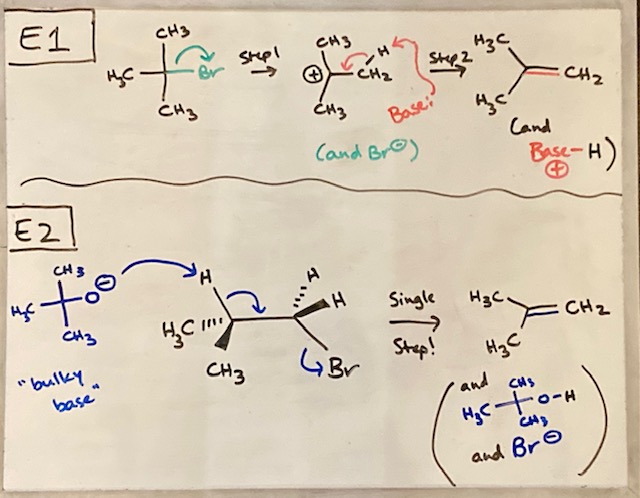
This last poem addresses two new types of reaction mechanisms that often compete with the nucleophilic substitution reactions seen in previous posts (SN1 and SN2). These two new types of reaction pathways are called eliminations, wherein a base reacts with (often) an alkyl halide to “eliminate” a hydrogen atom and the leaving group, ultimately yielding the formation of an alkene, a compound with a double bond. As with the nucleophilic substitutions, eliminations (represented generally as E) can occur via a two-step process (E1, for unimolecular elimination) or a single-step, concerted process (E2, for bimolecular elimination). Both are shown in the diagram below, using conventions of electron-pushing mechanisms.
Via E1, the bond to the leaving group breaks first, yielding a carbocation as the bromide ion leaves. As shown here, a neutral base with a lone electron pair then abstracts (removes) a proton, so that the electrons originally in that C-H bond form a new pi bond between two carbon atoms. Besides the bromide ion, which departed in Step 1, the other side product is the now-protonated generic base, from Step 2.
Via E2, the negatively-charged bulky base doesn’t have enough room to attack the alkyl halide as a nucleophile. Instead, it abstracts a proton, and the subsequent formation of a pi bond then causes the departure of the bromide ion as the leaving group, all in one reaction step. The leftover side products here are the now neutral tert-butanol and the bromide ion, both from the single reaction step.
As with the other poems from this month, before launching into the essay, it’s worth acknowledging the motivation: the “why do we care about this in the first place?” aspect of such complicated topics. These four reaction patterns (SN1, SN2, E1, and E2) are evident in a tremendous number of settings. Chemistry students traditionally begin their extensive training in chemical and biochemical mechanisms by learning these four options and learning how to predict which of the four is likely to predominate given a set of reaction conditions. The reactions have massive implications for organic synthesis, biochemistry, and many other branches of chemistry. However, trying to learn them in the first place can be imposing. This poem takes several aspects of the elimination mechanisms and presents them in a rhymed format, which ideally might be memorable for students learning the material.
“Rivaling SN, / An elimination will / Lead to formation of / Newfound alkene…”
Nucleophilic substitution reactions and elimination reactions “rival” one another: they involve comparable reactants that can accomplish multiple mechanistic steps, competing for the most likely pathway in a given situation. The reactant molecules in the reactions shown here could also theoretically undergo SN1 or SN2 reactions, respectively.
Why is this? Both bases and nucleophiles use electron pairs to achieve mechanistic ends: many molecules act as one or the other interchangeably. How a negatively charged species will act comes down to its own bulkiness and other reaction conditions. Does it have enough room to attack as a nucleophile, or is the organic molecule crowded (sterically hindered), so that abstraction of a proton is more feasible? Is it neutral or negatively charged? Many such questions help students make the “call” of whether SN2, SN1, E2, or E1 is occurring in a given scenario.
An elimination pathway yields a “newfound alkene”: a molecule containing a double bond.
“(E2 results from build / Anticoplanar; / Abstraction and leaving, / Coincident, seen.)”
Discerning between E1 and E2 mechanisms means considering characteristics of the reactant molecules, the base, the solvent, and other factors, in processes reminiscent of discerning between SN1 and SN2.
The new consideration for eliminations is that E2 has a geometric constraint (required 3-D arrangement) in the organic substrate. The proton that is abstracted from the alkyl halide and the leaving group must be “anticoplanar” to one another: in the same plane, on opposite sides of the molecule. “Abstraction and leaving [are] coincident”: these two steps happen in a concerted fashion, via E2.
“Diene and a dienophile In movement, concerted, beguile. Diels-Alder reaction Results in compaction: Route cyclohexenic in style.”
The penultimate mechanism-themed poem of NaPoWriMo 2022 was posted on 7 April 2022 and celebrated the Diels-Alder reaction, a well-known process in which two molecules combine to yield a single product.
Thus, this particular reaction is another early one from the curriculum of Organic Chemistry. As with the past three posts, this post is intended to help summarize some of the most pertinent material for students learning the reaction. Likewise, as with the other organic mechanisms cited in this series, it is probably useful to include a diagram.
This drawing uses the convention of the skeletal structure for simplicity’s sake: that is, only the “carbon skeletons” of the molecules are shown. Each vertex or terminus represents a carbon atom bonded to a number of hydrogen atoms appropriate to achieve its desired number of four bonds total (so it can obey the octet rule). For instance, the “dienophile” above, ethene in this case, is depicted as a short set of parallel lines. In a chemist’s reading, this translates instantly to H2C=CH2. Each of the two carbon atoms must be bonded to two hydrogen atoms, along with participating in the double bond. Moreover, electron movement in the reactants (left-hand side of the reaction arrow) is depicted via red curved arrows. The new bonds formed by these electron movements are shown in red in the product (right-hand side of the reaction arrow).
Covalent bonds in organic molecules are represented with lines; a single line represents a single bond (also known as a sigma bond), and a double line represents a double bond, consisting of one sigma bond and one pi bond. As the diagram shows, the two reactants that participate in a Diels-Alder reaction are classified as a diene (a molecule with two double bonds) and a dienophile (a molecule that wants to react with a diene). Here, the simplest diene is 1,3-butadiene, and the simplest dienophile is ethene; they yield the simplest Diels-Alder product of cyclohexene.
As with the last few weeks, we have much build-up and context here, given all of the shorthand and jargon inherent in a chemical mechanism. Ideally, this background will help the next 280 words or so make more sense.
“Diene and a dienophile / In movement, concerted, beguile…”
The Diels-Alder reaction involves the interaction of a diene and a dienophile. The mechanism is generally postulated to occur all at once (“movement concerted”), as shown with three red arrows of electron movement in the single reaction step. The electrons in each of the pi bonds here (a pi bond is often thought of as the “second” bond in a double bond) participate in what is called a cycloaddition. This means that two new bonds form between the diene and dienophile to yield a six-membered ring, as the single product takes on a hexagonal shape. Additionally, the electrons from a third pi bond shift their location.
“Diels-Alder reaction / Results in compaction…”
The reaction is named for Otto Diels and Kurt Alder, who published their findings in 1928 and received the Nobel Prize in Chemistry in 1950. The reaction results in the “compaction” of the molecular geometry of interest: it is smaller, since two reactant molecules have reacted to form a single product molecule.
“Route cyclohexenic in style.”
The reaction shown above, with the simplest possible dienophile and diene, yields a molecule named cyclohexene. The name gives us several clues about its structure: “cyclo” (the molecule is cyclic; it is a ring); “hex” (six carbon atoms are involved); and “ene” (the structure includes a double bond).
This closing line was my favorite from the mechanism poems, as I appreciated the wordplay possible with “scenic route” and “cyclohexenic route.” I also find the “scenic route” title fitting for this post, given the extensive background, since that phrase is often a euphemistic shorthand used to explain that something will take much more time!
“Lesson on SN1: Two-step-long journey Begins with the leaving group’s breaking away. Nucleophilic attack racemizes. (Activity, optical: lost in the fray.)”
The third mechanism poem from NaPoWriMo2022 was posted on 6 April 2022 and looks specifically at the process of unimolecular nucleophilic substitution, which is abbreviated as SN1. This is again a step-by-step depiction in which electron movement is represented by curved arrows; the poem again seeks primarily to communicate several attributes of the mechanism to an audience trying to learn them.
Here, the same net effect occurs as in the previous discussion of the SN2 process: an incoming nucleophile (Nuc) replaces a leaving group (LG) on a molecule. However, SN1 is a stepwise process that requires two distinct steps, rather than the concerted single step of SN2. (To reiterate from a few weeks ago: you’re not wrong. It’s confusing that the two-step process has the number one in its abbreviation! This is because the rate-determining step in an SN1 mechanism is the first step, which only involves one species.)
Shown above is a generalized depiction of this molecular process. Because this poem will discuss the three-dimensional structures of the molecules a bit more, the scene is much busier than for the SN2 poem/essay. The gist of this mechanism is as follows:
Step One) Reactant loses leaving group to form Intermediate. Step Two) Intermediate reacts with Nucleophile to form Products.
Before I launch into the discussion of the poem itself, it is worth remembering that several shibboleths accompany the vocabulary of organic chemistry, and a few will be cited here. A chemist pronounces the word “carbocation” as “car-bo-cat-ion”; a non-chemist would likely pronounce it as rhyming with “vacation.” “Racemization” is likewise pronounced in a non-intuitive way. Those are the two main terms seen in this entry (but as I think about it, the general topic might make for many more interesting poems for the next NaPoWriMo).
With all this buildup, the poem itself might well seem anticlimactic… but I will resolutely start the official 280-word count here.
“Lesson on SN1: / Two-step-long journey / Begins with the leaving group’s breaking away…”
In contrast to the SN2 mechanism’s single step, the SN1 mechanism is a two-step process. In Step 1, the reactant forms an intermediate, also called a carbocation: the bond between the leaving group and the rest of the molecule is broken, yielding the positively charged intermediate.
“Nucleophilic attack racemizes. / (Activity, optical: lost in the fray.)”
In Step 2, the carbocation intermediate reacts with an incoming nucleophile. Depending on the structure of the reacting molecule, a property called “optical activity” can sometimes be monitored during the SN1 process.
Above, the “Reactant” depicted (where X, Y, and Z all represent distinct substituents) is optically active. When placed into an instrument called a polarimeter, the “Reactant” would rotate the polarimeter’s light in a certain direction: dextrorotatory (d) for right; or levorotatory (l) for left, a behavior which is quantified as the sample’s “optical activity.” (Other notations for structural differences are often used, as well; rationalizing those would take this poem-explanation over its word limit!)
In Step 2, as shown, the nucleophile reacts with the “Intermediate” to form the “Products.” Why are there two? When the incoming nucleophile attacks, it can do so from the front or the back, relative to the planar (flat) intermediate. Each option happens 50% of the time, leading to what is called a racemate or racemic mixture: “[n]ucleophilic attack racemizes.” The final product mixture would NOT rotate the polarimeter’s plane-polarized light anymore: the optical activity has been lost.
Many aspects of mechanisms are framed in bellicose vocabulary (e.g., “nucleophilic attack”), as highlighted here by the closing descriptor for the optical activity: “lost in the fray.”
“A creative process, wall-stationed, With paintings long-lasting, emblazoned; The technique, pervasive On surface abrasive, Forms fresco through carbonatation.”
The second mechanism poem from NaPoWriMo2022 was the most general of the verses from that week, posted on 5 April 2022. It concerns the chemistry behind frescoes, an artistic medium seen widely throughout history and cultures, thus justifying to a reasonable extent (I hope) the pun in the post title.
The topic of fresco chemistry involves much fascinating science, art, and history. As with last week’s entry, the chemical reactions of interest here deserve some preliminary framing and additional words. Unlike the SN2 mechanism and others that will be described in future posts, this is a process reflecting general inorganic chemistry steps, rather than the specific electron pushing of organic molecule depictions. However, it still seemed to fit reasonably well in this week. Here, the abbreviations in parentheses denote the phases of the chemicals of interest: (s) for solid; (l) for liquid; (g) for gas; and (aq) for aqueous solution.
Step One: CaCO3 (s) → CaO (s) + CO2 (g) Step Two: CaO (s) + H2O (l) → Ca(OH)2 (aq) Step Three: Ca(OH)2 (aq) + CO2 (g) → CaCO3 (s) + H2O (l)
The fresco cycle shown here is a three-step process. The first two steps prepare an artist’s materials for this artistic medium. The first is called calcination: calcium carbonate (CaCO3) is heated to yield calcium oxide (CaO) and carbon dioxide (CO2). The second is called slaking: calcium oxide is mixed with water (H2O) to form calcium hydroxide [Ca(OH)2], known to fresco artists as lime plaster.
The third step is the chemistry behind the fresco formation itself and the focus of the poem.
“A creative process, wall-stationed, / With paintings long-lasting, emblazoned…”
Frescoes consist of two layers of lime plaster used to coat a wall and create a painting surface (“wall-stationed”). In the rougher layer, the arriccio, plaster is mixed with coarse sand and applied directly to the wall. The intonacolayer (lime plaster and fine sand) is then applied over the arriccio layer to become the actual painting surface.
In fresco chemistry, pigments are painted directly on a surface consisting of calcium hydroxide [Ca(OH)2]. As the fresco dries, the calcium hydroxide reacts with the carbon dioxide (CO2) in the air and forms the stable and long-lived compound calcium carbonate (CaCO3): trapping the pigments, leading to an image that will be “long-lasting [and] emblazoned” on the wall.
A fresco artist ideally applies an intonaco layer only to an amount of wall feasible to finish before the plaster dries. The corresponding term is giornata, for “a day’s work.”
“The technique, pervasive / On surface abrasive…”
The technique is “pervasive”: seen in many eras and locations throughout history. Calcium hydroxide is a basic compound, bases are caustic; lime plaster is a “surface abrasive.”
“…Forms fresco through carbonatation.”
The last reaction in the sequence shown is called carbonatation, as it forms calcium carbonate. It is sometimes called carbonation, but the first term is less ambiguous (multiple processes are denoted as carbonation)… and scans more readily in this limerick!
This reaction is key to the buon fresco(“good fresco”) technique, in which the artist is painting on fresh lime plaster, aiming to cover their giornata. A related technique is called fresco a secco (“dry fresco”), in which the artist uses paints on an already-dried surface.
“A nucleophilic incursion In polar aprotic submersion, With leaving group egress As synchronous process: It’s SN2 (Walden inversion).”
The 4 April 2022 limerick was the first in a week of posts that summarized specific organic chemistry mechanisms: step-by-step depictions of how molecules transform over the course of a given reaction.
I remember my introduction to chemical mechanisms as involving a tremendous amount of specialized vocabulary: with exams perpetually on the near horizon, it seemed like I needed to memorize several complicated terms long before I could process what each of them truly meant. This poem and the ones that follow are intended to put some of the key trends and words together in a memorable way for someone trying to learn the basics.
In a first for these essays, I think it will be useful to have a small illustration for a few of these, over the next five weeks. Some additional introductory words are likely useful here, too, since one of the few things I suspect of being even more off-putting than unexpected chemistry jargon would be an unexpected chemistry diagram!
In these diagrams, curved arrows show electron flow, which is the underlying impetus for all of these processes. The curved arrow starts where the excess electrons are and points to where they end up, in a given reaction step; electrons typically move in pairs (two at a time). Lines represent covalent bonds. Dash-wedge notation shows three-dimensional (3-D) arrangements of these bonds. A “wedged” triangle shows that the bond is coming towards the viewer, and a “dashed” triangle shows that the bond is behind the screen.
(This illustration is brought to you courtesy of the whiteboard setup still present in my kitchen, which has never quite recovered from being a Spring 2020 classroom.)
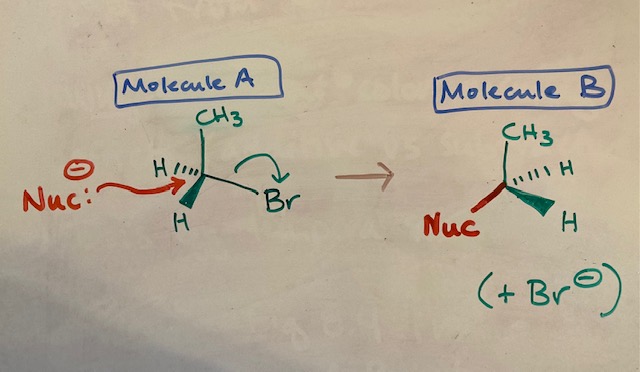
Finally, to turn back to today’s mechanism and limerick: one of the simplest mechanisms of interest in Organic Chemistry is the SN2 process, depicted above. Overall, it is a depiction of how Molecule A turns into Molecule B: how a negatively charged nucleophile (abbreviated generically as Nuc above) replaces the bromine atom in the original molecule; as part of the same process, the bromine atom “leaves” the original molecule, becoming a negatively charged bromide ion, also characterized as the leaving group.
“A nucleophilic incursion / In polar aprotic submersion…”
Two mechanisms commonly taught to organic chemistry students are SN1 and SN2: two types of nucleophilic substitution (abbreviated as SN) that were both celebrated during NaPoWriMo2022. Both involve a nucleophilic attack, or “incursion.” SN1 reactions occur via a two-step process; SN2 reactions occur via a single, concerted step. (This non-intuitive naming is because one species is involved in the rate-determining step of an SN1 mechanism, whereas two species are involved in the rate-determining step of an SN2 mechanism… since its single step is the only one!)
A perennial, early challenge for students is discerning via which mechanism a nucleophilic substitution occurs. One clue is the solvent (the reaction medium). SN2 reactions are favored by polar aprotic solvents (polar solvents that lack a proton; acetone is a common choice), while SN1 reactions are favored by polar protic solvents (such as water). “Polar aprotic submersion” denotes that the reaction occurs in polar aprotic solvent, hinting at SN2.
“With leaving group egress / As synchronous process…”
As shown above, in an SN2 process, the nucleophile attacks simultaneously with the departure of the leaving group (“leaving group egress”), since everything happens at once (a “synchronous process”).
“It’s SN2 (Walden inversion).”
The closing line reveals the SN2 label and a corresponding inversion of stereochemistry: the 3-D arrangement of the atoms. The inversion is named for Paul Walden, the chemist who studied the process in 1896, and can be detected when the reaction occurs at a chiral center (which is not the case shown above).
“The product in flask: data, quotes, looks; The time that each task, new or rote, took; Stoich calcs and dilutions; Key findings; conclusions; Next questions to ask… all in notebook.”
“The product in flask: data, quotes, looks; / The time that each task, new or rote, took…”
In this particular poem, it was fun to build towards “notebook” as the final rhyme, then shape the remainder of the limerick around it. This required some stretching of vocabulary, at times, but within reason, as is ideally clear by taking one line at a time.
A chemist would record information about “the product in flask: data, quotes, looks.” What is the product’s mass? Its melting point? What statements would the chemist wish to record about the experiment? What does the product look like?
Another common record included in the notebook would be “the time that each task, new or rote, took.” Each step in an experimental procedure is either a new attempt or a repeated (“rote”) one; further, it’s useful to know how long certain steps (heating under reflux, stirring, etc.) can take.
“Stoich calcs and dilutions; / Key findings; conclusions…”
The “A” rhymes in this limerick (with its AABBA form) all build on “notebook,” while the “B” rhymes are a bit less forced. The phrase “stoich calcs and dilutions” refers to the lab-focused mathematics completed in a lab notebook (theoretical yield and other stoichiometric calculations, M1V1 = M2V2, etc.). Perhaps the most obvious things to highlight in a lab notebook are the “key findings [and] conclusions” from a given procedure.
“Next questions to ask… all in notebook.”
The final line of the poem highlights the self-perpetuating nature of scientific research: what “next questions” do the conclusions of a given experiment invite? Those creative reflections are also an important part of a procedural record.
“To isolate via filtration, Consider the process notation: Whether vacuum or gravity Will the product compatibly Obtain, through work-up situation.”
The 10 April 2021 limerick discussed two additional work-up techniques useful in the organic chemistry laboratory: vacuum filtration and gravity filtration. Each is accomplished via the use of a specific type of set-up requiring a specific type of funnel, a fact which provides this essay’s title.
“To isolate via filtration, / Consider the process notation…”
This poem notes the distinction between two different techniques with confusingly similar names (both involving filtration). To complete an organic chemistry work-up and isolate a target compound, one must first decide which type of filtration is most useful, or “[c]onsider the process notation.”
“Whether vacuum or gravity / Will the product compatibly / Obtain, through work-up situation.”
Often in organic chemistry lab, a chemist seeks to separate a liquid from a solid via some kind of filtration, a relatively simple task accomplished by using glassware and filter paper.
If the target compound (the compound that the chemist wants to further analyze or use) is the solid, vacuum filtration is the work-up technique of interest. By using (typically) a Büchner funnel covered with filter paper and creating a vacuum, the solid is isolated and thoroughly dried on that paper. If the target compound is in the liquid phase, instead, then gravity filtration is used, with a glass stem funnel. Here, the filter paper catches any unwanted solid byproducts, and the liquid that passes through the paper and funnel continues into the next step of analysis or synthesis.
The goal with either type of filtration is to “compatibly / [o]btain” the target product while avoiding any additional impurities: to remove as much “extra” material as possible. If the product is a solid, then the vacuum set-up ensures that as much liquid as possible is removed. If the product is a liquid, then the slower gravity filtration ensures that no extra solid material is accidentally carried along. Common objectives in the lab involve learning both techniques and discerning between their optimal uses.


 Chemphasis
You must be logged in to post a comment.