Categories
Science Poetry

Arrow Analysis

“In reading reaction’s drawn evidence,
Consider notational relevance: 
What seems like a muddle
Of differences subtle
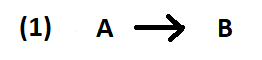
Resolves through an arrow analysis!”

I am back to campus for a new semester, and so it is helpful to also return to this writing routine. The second half of NaPoWriMo 2023 began with a set of Twitter poems highlighting “chemical notation week” in the hashtags, a theme that seems like a bit of a hard sell as I revisit these in early 2024!  I’ll plan on one post per poem, through the next several weeks; however, if the writing starts getting extremely dense, I might combine and summarize a few.

“In reading reaction’s drawn evidence, /
Consider notational relevance…”

The goal of this series of poems was to highlight how seemingly small differences in reaction arrow notation can play major roles in chemistry settings: how a “reaction’s drawn evidence” (its interpretation by another chemist) relies heavily on its specific “notational relevance” (the precise usage of the correct notation for the process of interest).  

This is a point that often can be frustratingly unexpected for chemistry learners: where what appears to be a small error results in what seems like a disproportionate effect on a graded assessment.  My goal was that this set of limericks would be an accessible and fun way to deliberately introduce and emphasize these important differences in notation.  

“What seems like a muddle /
Of differences subtle /
Resolves through an arrow analysis!”

The last three lines address what the themes of the next few poems and posts will be: first, that chemical reactions can communicate information that seems confusingly dense; second, that careful attention to these subtleties can resolve the confusion.  In particular, the many types of reaction arrows will be explored over the next several poems.

The last line relies on a pun between “error analysis,” which is a common theme of many lab reports, as the propagation of error throughout an experiment is quantified, and “arrow analysis”: the close examination of reaction arrows that these poems will involve. 

Categories
Science Poetry

Close Call

On precipice of winter-breaking,
With final-exam-prep painstaking,
These lines anapestic
Are far from majestic
(Last rhymed autumn-term undertaking).  

This non-Twitter poem probably requires little interpretation, near the close of a hectic semester, but I will give it a bit of additional context. 

On precipice of winter-breaking, /
With final-exam-prep painstaking…

We are in the last week of classes here, prior to Finals Week (and then the Grading/Meeting Weeks…), before a brief winter break. 

In the academic timeline, attention has thus shifted primarily to preparations for the final exams: reviewing and reflecting on the chemistry content from a busy semester.      

These lines anapestic /
Are far from majestic…

The metric feet used in limericks are anapests and amphibrachs. In this setting, the adjective form of the first lends itself particularly well to a sardonic rhyme, since my end-of-term work tends to focus primarily on simply accomplishing tasks, rather than achieving any sort of impressiveness in doing so!  The close of autumn term can seem particularly draining as the daylight wanes throughout the semester, whereas in spring, the shift back to longer daylight hours often provides a welcome boost in the last few weeks of the semester.         

(Last rhymed autumn-term undertaking).  

While it’s possible I might aim for a more extensive essay before year’s end, this will nonetheless be the last post during the autumn term itself, as highlighted in the last line. 

Together, the “precipice” of the first line and the semester’s drawing to a close are what prompted the title of this specific piece.

Categories
Science Poetry

Chalk Talks

“A compound in classrooms to celebrate,
As one writes, reflects, notes, or calculates:
A session’s board-chalking
Can supplement talking
Through cases of calcium carbonate!”

The 15 April 2023 limerick commemorated a chemical compound commonly found in academic spaces: calcium carbonate, as part of chalk.  

“A compound in classrooms to celebrate, / 
As one writes, reflects, notes, or calculates…”

I have been through decades of classes at this point, as a student and a teacher, so I have seen chalk employed for a variety of purposes in a variety of settings (for a variety of years).  The utility of chalk and a chalkboard for documenting a process— solving an equation, balancing a reaction, diagramming a sentence, outlining a story— is particularly pronounced.  While classroom chalk can also sometimes consist of other compounds, calcium carbonate is the focus of this particular poem, as the final line will reveal. 

“A session’s board-chalking /
Can supplement talking /
Through cases of calcium carbonate!”

One of the reasons I rely on the chalk/chalkboard combination in my teaching is that I can pace myself more reasonably, providing clear context for each step of solving a problem rather than going too rapidly toward the answer.  The “session’s board-chalking can supplement talking” and ensure I do not rush ahead.  (“Cases of calcium carbonate” is a needlessly complex phrasing for “boxes of chalk”!)  

As with many aspects of day-to-day academic life, the origins of both using chalk with a chalkboard and erasing chalk with a chalkboard eraser are more complex than I had previously realized.  A past exhibition in the Smithsonian highlights the importance of the chalkboard in math education and its use in the USA since the early 1800s, although similar uses had been established around the world for centuries previous.    

Categories
Science Poetry

Aims of Arrows

“In chemistry’s schemes mechanistic,
Find blend analytic-artistic…
See bonds’ breaking/forming;
Electrons’ unmooring:
All shown through line drawings, logistic.”

The 14 April 2023 limerick summarized an interesting overlap of chemistry and art, in terms of the drawings that chemists use to depict reactions.

In chemistry’s schemes mechanistic, /
Find blend analytic-artistic… “

I’ve written often about my interest in the chemistry underlying artistic techniques, such as frescoes and cyanotypes.  Another way in which chemistry and art overlap is with respect to the symbolic representations used to describe the step-by-step progress of chemical reactions; these representations are called mechanisms (or “schemes mechanistic”).  

Organic chemists, especially, spend much time learning to draw these “blend[s] analytic-artistic,” in which the logical flow of a set of steps can be followed from reactants to products.  

“See bonds’ breaking/forming; /
Electrons’ unmooring: /
All shown through line drawings, logistic.”

Mechanisms are also called “electron-pushing diagrams” or “arrow-pushing diagrams.”  Pioneered by Robert Robinson (1886-1975), the drawings allow a chemist to easily show the breaking and forming of bonds between atoms, as well as the movement of electrons within and between molecules, using curved arrows.  The arrows begin where the electrons are and point to where they will go, as shown in the substitution- and elimination-themed poems from last autumn.  

I’ve written recently on the power of line drawings in organic chemistry, where even a simple hyphen can be reasonably read by a chemist as the molecule ethane.  To read through a multi-step mechanism is to see the immense utility of these “line drawings, logistic” when used in communication among chemists.  

Interestingly, throughout NaPoWriMo 2023, I found it a fun challenge to describe in verse the considerable variety of arrows in chemistry, so I plan to return to this topic, with some additional poem-expanding essays, in early 2024.  “Aims of arrows” can thus be read as both summarizing the goals of these mechanistic drawings and pointing towards themes in the spring term.  

Categories
Science Poetry

Depiction Restrictions

“Depicting a shape three-dimensional: 
For chemists, a process intentional, 
As dash-wedge notation, 
A visual narration, 
Finds clarity through the conventional.”

The 13 April 2023 limerick described dash-wedge notation, a common drawing convention used by chemists to approach the challenge of representing three-dimensional structures in two-dimensional settings (in other words, how they deal with the “depiction restrictions” of the post title).  

“Depicting a shape three-dimensional: /
For chemists, a process intentional…”

The three-dimensional structures (shapes) of molecules help explain their functions.  A major goal in undergraduate chemistry coursework is learning to read and draw representations of these 3-D shapes from and in two-dimensional settings (e.g., chalkboards and notebook paper).  

Some of the drawing conventions are named for the chemists who devised them.  The Newman projection and the Haworth projection are named for Melvin Newman and Norman Haworth, respectively.  Newman projections allow chemists to consider conformational analysis, and Haworth projections help model concepts related to carbohydrate chemistry.  

“As dash-wedge notation, 
A visual narration, 
Finds clarity through the conventional.”

Several other such conventions, though, are not named for a specific scientist.  Indeed, it seems intriguingly hard (at least via the cursory searches that supplement these poems!) to track down a solid reference regarding the scientists who devised the sawhorse projection or the dash-wedge notation.  

The latter, named in this poem, is a “visual narration [that] finds clarity through the conventional.”  If a bond is written as a “wedge,” it is meant to be read by a chemist as coming towards the viewer, out of the plane of the screen/page/chalkboard.  If a bond is written as a “dash,” it is read as going away from the viewer, behind the plane of that surface.  This is a common notation that students learn to represent 3-D molecular structure.  

This limerick was a fun chance to simply highlight the rationale behind learning this visual and representational skill in chemistry coursework.  Overall, the historical saga of molecular representation in chemistry is fascinating and deserves many more words than the 280 assigned to this poem translation!  

Categories
Science Poetry

Light Reading

“A process creative: foundation
In wide-ranging, deep preparation.  
Then: steps incubating,
Scenes illuminating, 
And subsequent verification.”

The 12 April 2023 limerick summarized Graham Wallas’s model of creative cognition.  Wallas was a psychologist who lived from 1858-1932, and this specific discussion was presented in his 1926 book The Art of Thought, stating that creative insights occur via a four-step process.  

“A process creative: foundation / 
In wide-ranging, deep preparation.” 

The first step of Wallas’s model of creative cognition is preparation: the accumulation of knowledge and understanding over a long period of study.  

“Then: steps incubating, /
Scenes illuminating, /
And subsequent verification.”

The second step is incubation: a period of time wherein the individual is not consciously considering the question or topic as intentionally as in the preparation period.  The third is illumination, where the flash of inspiration or insight arrives in a moment (I often think of this as the most cinematic step).  Finally, the fourth step, that of verification, involves the idea’s testing and eventual validation by the larger community.  All four steps lend themselves quite well to the meter and rhyme scheme of a limerick!   

***

Interestingly, while such a narrative would not be part of a scientific journal article, this is often a pattern that can be seen in the stories of scientists’ discoveries, such as physicist Lise Meitner’s inspiration regarding nuclear fission (during a winter walk with another physicist, her nephew Otto Frisch) or chemist August Kekulé’s discovery of the structure of benzene (legend holds that he realized the key insight after waking up from a nap in front of the fireplace).    

These “illuminations” are the sort of moments I enjoy highlighting in limerick and double dactyl forms.  Moreover, these types of stories and Wallas’s model both suggest echoes of Louis Pasteur’s famous 1854 quote, always a favorite: “In the fields of observation, chance favors only the prepared mind.” Since this is (unbelievably) my 200th post here, it seems a fitting opportunity to revisit some of these words.    

Categories
Science Poetry

Charges Ahead

“The process of ionization:
A charge-causing classification;
Electrons lost/gained
Yield an ion proclaimed
From an atom once neutral in station.”

The 11 April 2023 limerick returned to familiar themes seen on this website, building on a common chemistry term with a variety of flexible rhymes!  

“The process of ionization: /
A charge-causing classification…”   

Ionization is the process of converting a neutral atom to a charged ion: it is thus “a charge-causing classification.”  

The “first ionization energy” of an element refers to the energy required to accomplish the process shown here, where the neutral element X is converted to the singly-positively-charged cation X+, by losing an electron (e).  As defined, this is a gas-phase process (shown here via the phase label of (g)).  

X (g) → X+ (g) + e

One of the most reliable periodic trends is that first ionization energy increases for elements going across a row (left to right) of the periodic table and decreases going down a column.  This is because it becomes easier to remove an electron from an atom as the atom increases in size, and atomic radius decreases across a row (left to right) and increases down a column.    

“Electrons lost/gained /
Yield an ion proclaimed /
From an atom once neutral in station.”

In a neutral atom, the number of protons (which are positively charged) balances out the number of electrons (which are negatively charged).  If an atom loses or gains electrons, this balance is upset, and an ion results!  In other words, an “ion [is] proclaimed, from an atom once neutral in station.” If an atom loses electrons, it forms a positively charged ion, which has more protons than electrons and is called a cation.  If an atom gains electrons, it forms a negatively charged ion, which has more electrons than protons and is called an anion. 

Categories
Science Poetry

Take Five

1.

“Observe both the rhyme and the reason
Of the typical turn of the season
From mornings’ sunrising
To sights more surprising:
Poetic-prosaic cohesion.” 

2. 

“Computing NaPoWriMo status:
One-third of the way through month’s practice
In steps non-orchestric;
Most feet anapestic,
With rhyme-scheming, far from exactness.”

The 9 April 2023 and 10 April 2023 limericks both paused from celebrating chemistry-specific themes.  Since they are in the midst of my fifth attempt toward this NaPoWriMo routine and they collectively provide a bit of a break from chemistry translation, “take five” seemed like an appropriate sentiment to share.   

“Observe both the rhyme and the reason
Of the typical turn of the season
From mornings’ sunrising
To sights more surprising:
Poetic-prosaic cohesion.” 

April brings the turn from winter to spring, and I had posted several pictures highlighting this welcome change during April: the vivid red of a cardinal against a deep blue sky, a contemplative squirrel, a rabbit in the sunrise, blossoms budding on a tree.  The earlier sunrises, while not specifically commemorated photographically, are some of my favorite indicators of the spring.  

It is interesting to revisit this now during the opposite transition, as summer turns to autumn, but such a change brings welcome sights of its own, the combination of the “rhyme and the reason” inspired by nature persists.  Below is one photo highlighting a still-welcome-but-more-autumnal moment of “poetic-prosaic cohesion.”  

***

“Computing NaPoWriMo status:
One-third of the way through month’s practice
In steps non-orchestric;
Most feet anapestic,
With rhyme-scheming, far from exactness.”

The second of these two poems recounted a rather mundane fact– that we had reached April 10– in a periphrastic way, relating it back to the National Poetry Writing Month routine: “One-third of the way through month’s practice.”  The inexactness of these poems could be deliberately highlighted in a humorous way: the lack of lyrical precision (“non-orchestric” standing in here as a shorthand); the defiance of even the standard rules of the limerick (most poems in 2023 fell in this category, but not all); the acknowledgement of quite a few faulty rhymes… as certainly seen here.        

***

I’ll return to the chem-specific poems next week, but it can be helpful to take a brief break from the more technical content here, near the midpoint of the semester.  

Categories
Science Poetry

On Occasion

“Organic-galvanic:
A. Wilhelm von Hofmann’s
Synthetic lab efforts
T’ward aniline dyes
Yield rearrangement and elimination;
Molecular models; and
Name schemes devised.”    

The 8 April 2023 Twitter poem marked a rare occasion where I was able to both 1) realize a chemist had a birthdate during NaPoWriMo and 2) commemorate it on the appropriate day, as noted in the essay title.  This poem summarizes some of the accomplishments of August Wilhelm von Hoffman (1818-1892), who (contrary to the intermittency perhaps suggested by the title!) contributed countless major insights to the field of organic chemistry throughout his career.   

“Organic-galvanic..” 

August Wilhelm von Hofmann was a synthetic organic chemist whose work spurred many research advances, galvanizing the field in multiple ways.  Moreover, I had not realized until writing this essay that he was one of the first scientists to actually use the phrase “organic synthesis,” making the first line even more fitting.       

A. Wilhelm von Hofmann’s /
Synthetic lab efforts /
T’ward aniline dyes..” 

Hofmann’s overarching endeavors in the experimental organic lab involved discerning the properties and components of coal tar, a byproduct of the coal industry.  He showed that it was largely composed of aniline, a compound consisting of an aromatic hydrocarbon ring bonded to an amino group (-NH2).     

As Hofmann and his research students worked on exploring coal tars generally and this compound specifically, several overlaps and discoveries arose regarding the possibility of using these highly conjugated compounds to form synthetic (lab-made) aniline dyes— a lucrative endeavor given that, previously, dyestuffs were available only via natural sources.  

(Perhaps most famously, one of Hofmann’s research students, William Henry Perkin, synthesized mauveine in 1853, having used aniline as a starting material in a potential synthesis of quinine that went serendipitously awry.)    

“…Yield rearrangement and elimination; /
Molecular models; and /
Name schemes devised.”
 

These last few lines summarize a few more accomplishments from Hofmann’s storied career.  Multiple organic chemistry reactions are named for him, including the two (the Hofmann rearrangement and the Hofmann elimination) specifically noted here.  He also pioneered the use of molecular models, building kits akin to chemical Tinkertoys that students use to simulate the three-dimensional structures of molecules, noting how atoms bond to one another.  Finally, he contributed to the nomenclature (naming) rules for organic compounds.  

Categories
Science Poetry

Flask List

“Consider the chem flask deemed conical;
Of glassware, example canonical.
Or: name Erlenmeyer 

Cohesive-inspires.
Both names, in lab ways: economical.”

The 7 April 2023 Twitter limerick focused on a common piece of glassware found in the laboratory setting.  

“Consider the chem flask deemed conical; /
Of glassware, example canonical.”

I’ve written before about the “lab check-in day,” in which students evaluate the contents of their lab drawers to make sure they have all the different pieces of lab equipment they will need throughout a semester.  It can be an overwhelming introduction, given the general novelty of both the materials and the vocabulary.  

Often, labeled charts of glassware are helpful in matching name to item for these long lists, as with this outstanding resource available on the blog Compound Interest. (The post title semi-acknowledges this, but it primarily was chosen due to its rhyme with the more common saying of “task list”!)    

The “chem flask deemed conical” (#4 at the link above) often has one of the most familiar shapes, in terms of its use in a lab setting.  It is a classic, “canonical” example of scientific glassware.  Typically, students checking into their labs will find that they have a wide variety of these flasks (100 mL, 250 mL, 400 mL, etc.), in order to be able to work with a wide variety of volumes of reagents on common laboratory tasks such as filtration and recrystallization.      

“Or: name Erlenmeyer /
Cohesive-inspires. /
Both names, in lab ways: economical.”

A conical flask is also known as an Erlenmeyer flask, named for its inventor (Emil Erlenmeyer).  The two names reference the same piece of glassware, which (as noted above) is one of the most prototypical pieces of equipment in an introductory lab.  

Thus, by either name, the flask “cohesive-inspires”: its image and name can stand in as visual, “economical” shorthands for the equipment used in a wide variety of scientific experiments and endeavors.